How do you plan courses and terms at a dance school?
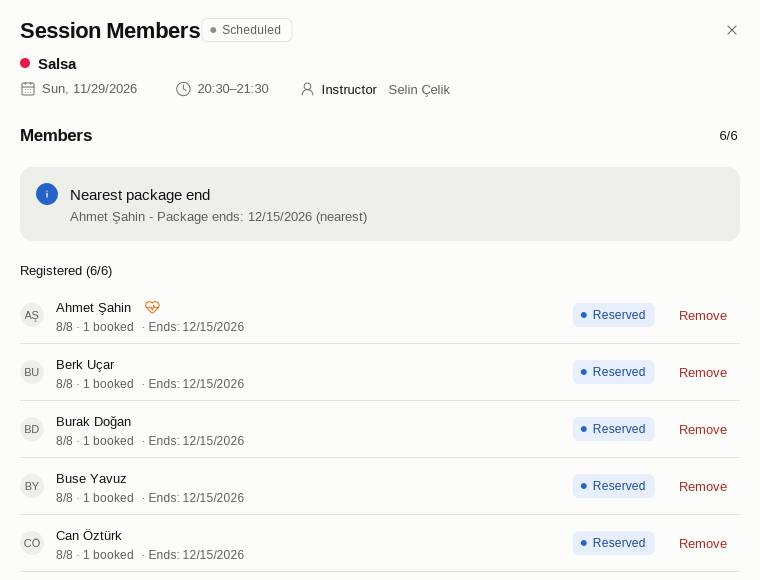
A course is one level of one dance style, held on a set day and time with the same group for a whole term. The term plan fixes the start and end dates first, then the day, room and instructor of each course. When a course runs as a repeating series to the last day of term, a student's place is not written in again every week and only the exceptions change by hand.
| Course | Level | Day and Time | Term |
|---|---|---|---|
| Salsa | Beginner | Tuesday 7:00 PM | 12 weeks |
| Salsa | Intermediate | Thursday 8:00 PM | 12 weeks |
| Bachata | Beginner | Monday 8:00 PM | 8 weeks |
| Tango | Advanced | Saturday 2:00 PM | 12 weeks |
| Children's ballet (ages 7-10) | All Levels | Saturday 11:00 AM | 12 weeks |
- Fix the term's start and end dates before the courses; each course's last class follows from them
- Running the same level of the same style on two days creates a parallel group for make-ups
- A room holds one course at a time; putting two courses in the same hour needs a second room
- An age group is not a level: open children's and adult courses as separate classes
- Mark holiday weeks while planning the term, and move the end of term to match
Definition of the term: Recurring series
How do you split level groups, and how does a student move up?
A level belongs to both the class and the student: a Beginner course gathers newcomers, Intermediate and Advanced courses gather those who know the figures. Placing a student in a course that does not match their level needs a reason. When a student moves up, their own level is updated first, then they join the new course's series and their seat in the old course is removed.
- All Levels
- Open to everyone: open classes, children's courses and social dance nights where no level split is made.
- Beginner
- A course that starts from the basic steps. A new student or a trial visitor usually starts here.
- Intermediate
- A group that knows the basic figures and works on flow and partnering. Moving up follows the instructor's judgment.
- Advanced
- A group that wants choreography and technical depth. Show and competition preparation often happens at this level.
In Dakik a level is one of four fixed values, and it binds: a student whose level does not match the session's is placed only with a written reason, while an All Levels session takes anyone. The dance style or the age group is not a level but the class name; "Salsa Beginner" and "Children's Ballet 7-10" open as two separate classes.
How do you choose between term, monthly and drop-in packages?
A term enrollment is a package with as many credits as the term has classes, ending with the term, and it keeps a course group together. A monthly package suits a student who comes to more than one style or does not want to commit to a term. A single class suits open classes and newcomers who have not decided yet. Most schools offer all three, each with its own rule.
| How It Is Sold | Package Type | Credits or Limit | Validity | Who It Suits |
|---|---|---|---|---|
| 12-week term enrollment | Credit | 12 classes | 90 days | A student who stays with one course for the term |
| Monthly 8 classes, two styles | Credit | 8 classes, at most 4 per style | 30 days | A student in two different courses a week |
| Open classes, monthly | Duration | Up to 2 classes a week | 30 days | Someone coming to open classes such as zumba or social dance |
| Single class | Credit | 1 class | 14 days | An undecided newcomer or an occasional visitor |
| First class | Trial | 1 class | 7 days | Someone trying the school for the first time |
The class counts and periods are an example. Keeping a term enrollment valid a few days beyond the term leaves room to make up a class missed in the last week. In a package covering two styles, a cap on each style stops a student spending every credit on one; a style without a cap stays unlimited.
How do you enroll a student who joins mid-term?
A student who arrives after the term has started joins the course's series from the week they come and buys a package with as many credits as the term has classes left. That way they do not pay for the weeks they missed, and they finish with their group at the end of term. A private class or an extra class at the level below can help them catch the early figures.
Count the classes left
Count the classes from the student's first one to the last class of the term, leaving out holiday weeks.
Define a package for the classes left
Sell a package with that many classes, priced from the term fee divided per class.
Add them to the course as a standing member
The student is placed in that week's session and in the series' later classes as well.
Help with the missed figures
Suggest a private class, or an extra class at the level below, to a student who missed the first weeks.
A student added to a series before their package is defined has their seat held as Awaiting Package; it turns into a booking once the package is in.
How is a missed course class made up?
A missed course class is best made up in another group's class at the same level. For that the package has to allow make-ups, the student has to cancel within the window the rule allows, and the parallel group has to be inside the package's scope. The make-up window should not run past the end of term, and what happens to an unused make-up when the term closes should be written down in advance.
- No Make-up Credit
- The student cannot cancel or move a class; a class they miss spends its credit. Suits short, intensive courses.
- Reschedulable
- The student can only move a class to another session within the set number of days; the credit is not banked.
- Poolable and Reschedulable
- The student can cancel a class into the make-up pool, or move it straight to another session.
- A make-up credit is used only in classes its package covers; add the parallel group to the package's scope
- A student who cannot come for an emergency after the window has closed can be marked Excused in attendance; the credit is kept, as a make-up credit on a Credit package or back in a package that gives no make-ups
- A class the school cancels, or one falling on a closed day, returns its credit straight to the package, outside the student's rule
- A make-up window never runs past the package's end: when the term closes, unused make-up credits end too
Make-ups and freezes in detail: Make-ups and Freezing
How do you set up couples classes and private classes?
A couples class is a private class for two, sold apart from the group course: preparing a wedding dance, or a couple who want to progress at their own pace. A set number of classes for one goal is a duo package of that many classes, and each partner joins the class with their own package. A one-to-one private class follows the same logic as a package for one.
- A couples class opens as the Duo class type; the class type fixes the session's capacity at two
- Each partner is a member of their own and joins with their own duo package; one may pay for both, but the booking is for two people
- For a set goal, such as a six-class wedding dance program, build a package with that many classes
- A group package cannot be used in a couples class, nor a duo package in a group course; a package books sessions of its own class type
- Rotating partners in a group course for students who come alone is the school's own arrangement; the software does not track it
What a private class earns per hour: Group vs Private Class Profitability
How do you pay a dance instructor?
Dance schools mostly pay instructors per class; with an instructor who teaches full, established courses, revenue share or a per-participant rate is worth discussing. For an instructor who spends most of the week at the school, a monthly salary with a per-class bonus is another common route. Whichever model is chosen, attendance decides the sum: which classes took place and who came.
- Per Class
- A set fee per class held; protects the instructor in a new or small course.
- Per Participant
- A fee for every student who comes; gives the instructor a stake in filling the course.
- Revenue Share
- A percentage of the class value of the students who attend; suits an instructor with established courses.
- Monthly Fixed
- A salary for an instructor who spends most of the week at the school.
In Dakik a per-class or per-participant rate is entered class by class: the same instructor can earn one rate for a group course and another for a couples class. A class with no rate set brings no pay and is listed separately on the Staff Details page.
Run it with your own numbers: Instructor Pay Calculator
How does a dance school move from a spreadsheet to software?
The cleanest move happens at the start of a new term, because course groups and enrollments are set up again that day anyway. Styles, rooms and instructors come first, then the packages; courses open as series repeating through the term, and students are brought over with their packages and added to their courses as standing members. The sign-in link goes to students last.
Define the classes, rooms and instructors
Open each style and level as its own class; enter each room's capacity and each instructor's pay.
Set up the packages
Define the term enrollment, the monthly package, the single class and the couples package with the classes they cover and their cancellation rules.
Open the courses for the term
Save each course with its day, time, room, instructor and level as a series repeating to the last day of term.
Bring the students over and add them to their courses
Move the student list with its packages through Data Import, then add each student to their course's series as a standing member.
Send the students the link
A student with an email address on record gets an invitation; they see their classes and package and handle cancellations and make-ups as far as the rule allows.
The move in detail: Moving from Spreadsheets
How does Dakik run the term at a dance school?
Dakik runs courses as series repeating through the term, adds each student to a series once as a standing member and applies the package rule itself. A student cancels, moves or makes up a class from their own phone, and instructor pay is worked out from attendance.
Through the term, Dakik runs the work behind the courses:
- It keeps courses as series repeating through the term; you add a student to a series once as a standing member
- It applies term, monthly, single-class and couples packages with their own cancellation, make-up and freeze rules
- It asks for a reason when a student's level does not match, and shows room and instructor conflicts before you save
- A student cancels, moves or makes up a class from their own phone, and waits for an offer on a full class
- It works out instructor pay from attendance, at a rate set class by class
Dakik for dance schools: Dance School Software
Courses and the conflict check: Schedule
Cancellation rules and make-ups: Make-up and Freezes
Instructor pay: Instructor Pay
Frequently asked questions
How do you keep a child student's record on behalf of a parent?
Dakik has no parent accounts; the child is registered as a member under their own name. A child with no email address is added without one, cannot sign in to a panel of their own, and the school manages their package and classes. The same phone number can be saved on more than one member, so a parent's number can sit on siblings' records. An email address, however, belongs to one account.
How do you put end-of-year show rehearsals on the calendar?
Rehearsals open as one-off sessions or a short series apart from the course's own series, so the regular course schedule stays as it is. If a rehearsal should not spend a package credit, it can be set up with a free package or as a separate class. Send Announcement sends an app notice to the students you choose; a student who does not use the app has to be told another way.
Can a new student come to a trial class before the course starts?
Yes. If the Business Page is on, a newcomer picks an All Levels or Beginner session themselves with Book a Trial Class. The school can also define the trial package and place the student itself. A person gets a trial package only once. After the trial, the student can join their course with a package built on the number of classes left in the term.
What happens to course classes in a holiday week?
When the days the school will be shut are added to Closures, the sessions on those days are canceled, the credits held for them go back to the packages and the packages run longer by the number of closed days. If a course has lost a week, extending the term by a week or moving the lost class to another day is planned separately, and students should be told which one in advance.