Who sets the cancellation rule?
The studio sets it and writes it into the package definition; it is not renegotiated with each member. The definition holds three things: how many hours before the class it may be canceled, how often that may be done, and what happens to the credit. The member cancels inside that rule from their own panel.
- The rule lives in the package definition, not in an understanding with the member
- The member cancels inside the rule from their own panel
- Only the Owner or an Admin can open an exception, by writing down a reason
Where does a canceled class credit go?
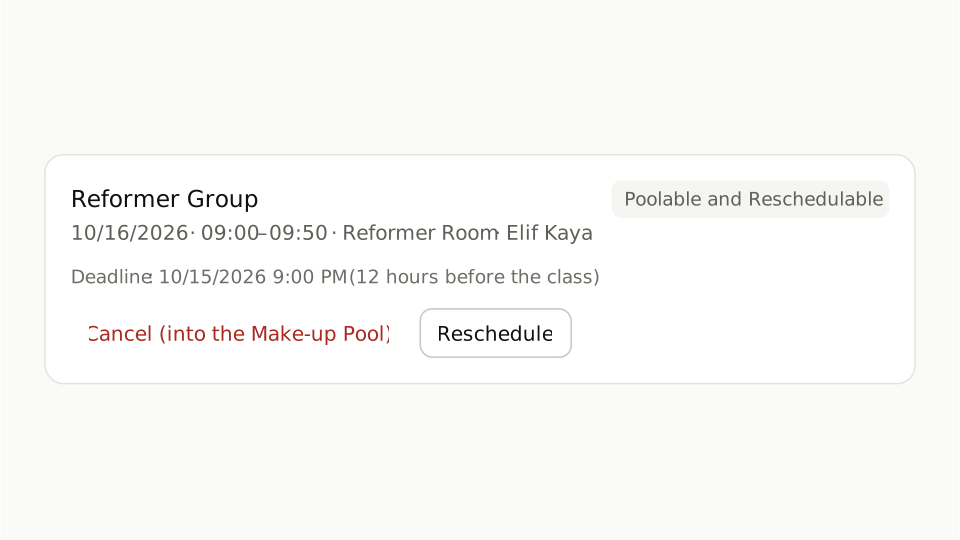
There are three possibilities, and the package's make-up permission says which one applies. The credit either never comes back, or attaches to another session as it moves, or enters the Make-up Pool. A credit in the pool waits: it comes off when the member picks a session that suits them later.
| Who canceled | Where the credit goes | Does the rule apply |
|---|---|---|
| The member, inside the rule | Per the package's make-up permission | Yes |
| The member, outside the rule | Subject to approval by the Owner or an Admin | Opened with a reason |
| The studio (a room or instructor block) | Straight back to the package | No |
Only under the Reschedulable permission does a cancellation stay out of the pool: the member moves the class straight to another session, and the move counts towards the cancellation limit too. If several credits have built up in the pool, a new booking spends the one closest to expiry first, so the credit nearest to being lost is not wasted.
What changes when the studio cancels?
A studio-side cancellation is not weighed the same way as a member's. When a room or an instructor is blocked the session drops and the held credit goes straight back to the package: neither the cancellation window nor the weekly frequency applies. A seat paid by a make-up credit gets it back unrestricted. A member does not lose a credit, or their turn to use one, over a cancellation they did not make.
A held credit going straight back to the package after a studio-side cancellation is the rule rather than an exception to it: nobody pays for a cancellation they did not make.
How does the make-up window work?
A credit in the pool does not wait for ever: the package's own validity period bounds it too, so a make-up has to be used before the package ends. That is why the make-up permission has to be thought about together with the package length - a generous permission on a short package produces a credit nobody can spend.
An example: for a class canceled on day 26 of a 30-day package, the credit ends on the package's last day even if the make-up window is 7 days. The member has 4 to 5 days for the make-up, not 7. Telling the member this on packages close to their end saves an argument on the last day.
Which classes can a make-up credit be used in?
A make-up credit works in the classes its own package covers, in a session that starts before the credit expires. A credit from the member's own cancellation lands only in sessions open to rescheduling, and the studio can close a session to that. An unrestricted credit from a removed make-up seat is not held back by that setting. When a fitting make-up credit exists, a booking spends it before the package credit.
- Scope: the credit works only in the classes its own package covers
- Time: the session has to start before the credit expires
- Restricted credit (the member's cancellation): only sessions open to rescheduling
- Unrestricted credit (a make-up seat removed by a studio cancellation or a freeze): any fitting session until the package's last day
- A make-up credit can book a seat even when the weekly class limit is used up
Closing a session to rescheduling also closes its waitlist and takes the session out of the member's move and make-up options. Unrestricted credits from a studio cancellation or a freeze are not affected by that setting.
How does a week play out with one cancellation a week and a 12-hour rule?
Take an example week: the package has a 12-hour cancellation window, one cancellation a week, a 7-day make-up window and the pool permission. The first cancellation inside the rule adds a credit to the pool; a second cancellation that week, or one past the window, cannot be made from the member panel. A studio cancellation never enters that count at all.
| Event | Result | Make-up credit |
|---|---|---|
| The Monday 19:00 class is canceled on Sunday at 18:00 (25 hours ahead) | Inside the rule; the week's cancellation is used | Enters the pool, valid until the next Sunday 18:00 |
| A cancellation of the Wednesday class is asked for on Tuesday | The weekly limit is used up; not possible from the member panel | Only the Owner or an Admin can open it, with a reason |
| A cancellation of the Friday 09:00 class is asked for at 06:00 that day | Past the cancellation window; outside the rule | None; if the member does not come the credit counts as used |
| The studio blocks Saturday for a holiday | A studio cancellation; outside the count | None; the held credit goes straight back to the package |
| The following Monday | A new calendar week; the weekly allowance resets | The first cancellation inside the rule goes to the pool again |
The hours and windows are chosen for an example package. The real values of the window and the limits come from each studio's own package definition.
How does freezing a package affect its end date?
A freeze moves the end date out by as long as the freeze lasted, so a package does not melt while a member is on holiday or injured. How long it may be frozen is written in the package definition, so it is not decided member by member. When the freeze runs out the package carries on from where it stopped.
- The freeze allowance is set in the package definition
- The end date moves out by as long as the freeze lasted
- When it runs out the package carries on from where it stopped
How does the waitlist come in on a full session?
When the seats are gone the member joins the waitlist, which is not a booking, so no credit is held. When someone on the list moves up a booking is created and a credit is held for the class then. Cancellation and the waitlist work together: one member canceling is how another gets into that hour.
- The waitlist is not a booking; no credit is held
- A member who moves up gets a booking, and a credit is held for the class then
- One member canceling is how a member on the list gets into that hour
A waitlist opens only on a session that is full, has not started and is open to rescheduling. If the session still has a free seat, the member is sent to a booking rather than to the list.
No-shows and late cancellations: No-Shows and Late Cancellations
How are the make-up pool and freezes managed in Dakik?
In Dakik the cancellation, make-up and freeze rules are written into the package definition and copied onto the member's package at the moment of sale. The member makes a cancellation inside the rule from their own panel, and the application checks the window and the weekly count itself. Make-up credits show in the member panel with their expiry; a freeze lists future bookings in a preview and moves the end date out on its own.
- Three make-up permissions: No Make-up Credit, Reschedulable, Poolable and Reschedulable
- A cancellation window of 0 to 720 hours, a make-up window of 1 to 365 days
- The cancellation frequency counted per week or over the whole package
- An exception to the rule opens only with a reason from the Owner or an Admin, and is recorded
- A freeze cannot be backdated; ended early, the unused days are taken back
On the features page: Make-up Pool and Freeze
Frequently asked questions
How long does a make-up credit stay valid?
A make-up credit created by the member's own cancellation ends when the package's Rescheduling Window runs out or when the package's last day ends, whichever comes first. The window is set in days, from 1 to 365, and counts from the moment of the cancellation. Unrestricted make-up credits, given back when a studio cancellation or a freeze removes a seat booked with a make-up credit, stay valid until the package's last day.
On which day does the weekly cancellation allowance reset?
The weekly limit counts per calendar week starting on Monday, and a cancellation comes off the week the class falls in, so canceling next week's class today leaves this week's allowance intact. Moving a class counts towards the same limit. The limit can also be set per package; then it never resets and counts the total until the package ends.
What happens to future bookings when a package is frozen?
Before the freeze is saved, the bookings that fall inside it are listed in a preview. If they are removed, their held credits go back to the package, seats booked with a make-up credit get it back as an unrestricted make-up, and the freed seats open to the waitlist. As the end date moves out by the length of the freeze, make-up credits tied to the old end date move to the new one too.
Can a package freeze be ended early?
Yes. If a member comes back sooner than planned, the Owner or an Admin can end the freeze early. The freeze days not used are taken back from the end date, so the end date moves out only by the days that were actually frozen. That way a member gains no extra time for days they did not really take off.
How many times, and for how long, can a package be frozen?
The studio decides with two settings in the package definition: how many times it may be frozen and how many days one freeze may last at most. In Dakik the count runs from 1 to 12 and a single freeze from 1 to 365 days. A freeze cannot be backdated; it starts today or on a later date.