How does a no-show differ from a late cancellation?
In a late cancellation the member tells you; in a no-show they do not. The difference matters to the studio: a late cancellation still frees a place that someone on the waitlist might take, while a no-show leaves that place empty for the whole hour. Most studios treat a late cancellation as outside the rule, but not as harshly as a no-show.
- Cancellation inside the rule
- The member cancels within the window. The credit follows the package make-up policy.
- Late cancellation
- The member tells you, but the window has closed. The credit is lost by rule; the Owner or an Admin can make an exception with a reason.
- No-show
- The member does not arrive and says nothing. The place stays empty and the credit counts as used.
What happens to the credit when nobody turns up?
The booking held the credit for that class, and a No-show mark takes it off the package just as Attended does. A no-show counts as a credit used, because the place was held for that member and could not be given to anyone else. A studio can open a one-off make-up, but that is an exception: make it the rule and a no-show costs nothing.
- The credit is held at booking and used once attendance is taken or the class takes place
- In a no-show the place went to nobody, so the credit does not return
- The Owner or an Admin can give the credit back as a goodwill gesture by editing the sold package
- A studio cancellation is never counted as a no-show
A Duration package has no credit to lose, but not turning up still costs something: on a package with a weekly class limit, the booked seat counts as one of that week's classes even if the member never came. A member with a limit of two classes a week who misses one has only one class left for that week.
Where a canceled credit goes: Make-ups and Freezing
When is attendance taken, and by whom?
The attendance list opens once the session has started; a session that has not started, or was canceled, takes no attendance. The session's own instructor can always mark it, and so can other staff with the permission. Each member is marked Attended or No-show, and anyone left alone stays Unmarked. A wrong mark can be corrected later, and who marked it and when stays on the record.
- The list is marked all at once or member by member
- A No-show mark takes the held credit off the package, just as Attended does
- For a member who attends on an Awaiting Package record, the credit comes off once a package is defined
- A member with no mark stays Unmarked and is left out of per-participant pay
How many hours should the cancellation window be?
There is no single right answer: the window should be as long as it takes you to fill the place again. With a full waitlist six hours is enough; with an empty one even twenty-four hours is short. Widen it and members are comfortable; narrow it and the studio carries fewer empty places.
| Window | For the studio | For the member |
|---|---|---|
| 4-6 hours | Little time to fill the place | Comfortable, flexible |
| 12 hours | Enough if there is a waitlist | Reasonable for most members |
| 24 hours | Easy to fill the place | Asks them to plan ahead |
Choose the window against your waitlist: with nobody waiting, a long window fills no empty place - it only makes life harder for the member.
Because the window lives in the package definition, each package can have its own: 24 hours on a private-class package, say, and 12 hours on a group package. An hour freed in a private class is harder to sell to someone else, so a longer window is easier to defend there.
How do you handle a member who cancels often?
You manage the frequency, not the individual cancellations. The weekly cancellation limit in the package definition does this by itself: the member cancels from their own panel up to the limit, and only the Owner or an Admin can go past it, with a written reason. The conversation then rests on the record rather than on who remembers what.
- The weekly cancellation limit lives in the package definition
- Up to the limit the member cancels from their own panel
- Past it only the Owner or an Admin can make an exception, and the reason is recorded
- The conversation rests on the record, not on remembered incidents
The limit can be counted two ways: weekly, a count that starts over every Monday, or as a total over the whole package. Moving a class counts towards the same limit. A weekly limit suits a member who comes regularly; a per-package limit gives some slack to a member whose work throws up the odd surprise, while still capping the total.
How does a freed place get filled?
A freed place is filled by the waitlist, not by ringing round. The moment a cancellation lands, the place opens to the first member waiting and they are told; if they take it, a booking is made and a credit is held for the class right then. Nobody has to make a call, and nobody argues about whose turn it was.
The cancellation lands
The member cancels inside the rule and a place opens in the session capacity.
The waitlist is told
The next member waiting is notified that a place has opened; nobody has to phone anyone.
A credit is held for whoever takes it
A booking is made, a credit is held for the class at that moment, and the session shows full again.
How do you calculate a no-show rate?
The no-show rate is the number of members who did not turn up over a period, divided by the bookings whose attendance was taken: No-show / (Attended + No-show). Unmarked records stay out of the sum, so the missing attendance has to be filled in first. Following the rate by hour and by member, not only for the whole studio, shows which class or which member the problem gathers around.
| Item | Count | Note |
|---|---|---|
| Bookings | 300 | Bookings made over the month and not canceled |
| Attended | 270 | Goes into the attendance history and instructor pay |
| No-show | 18 | The credit counts as used |
| Unmarked | 12 | Fill these in before working out the rate |
| No-show rate | 6.25% | 18 / (270 + 18) |
| 7:00 AM classes only | 15% | 6 / (34 + 6): the problem may sit with the hour |
The figures in the table are an example, not an industry average. When you set your own threshold, compare your own past months rather than a number from elsewhere.
Where should the rule be written for members?
A rule belongs where a member could break it. The best place is the booking screen: as they hold the place, they see how many hours ahead they may cancel and how many cancellations the week allows. An announcement sent afterwards only ever reminds them once the rule has already been broken.
- The rule is on the booking screen, where the place is held
- The package shows the cancellation deadline and the weekly limit together
- The reminder goes out before the cancellation window closes
- When an exception is opened, its reason enters the record
Setting up class reminders: Class Reminders
How are attendance and no-shows tracked in Dakik?
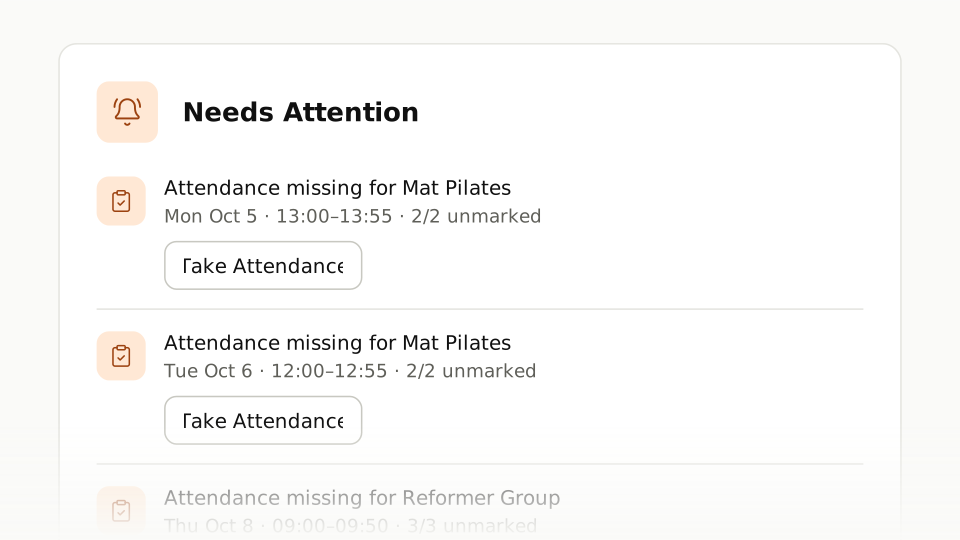
In Dakik attendance is taken from the session's own screen: once the session starts the participant list opens and the instructor marks each member Attended or No-show. The mark reaches the member's class history and the instructor's pay at the same time, and sessions still missing attendance are listed on the pay screen. Because the cancellation rule lives in the package, the application itself refuses a cancellation past the window.
- Attendance opens when the session starts; the session's instructor can always mark it
- Attended, No-show and Unmarked show in the member's class history
- Per-participant pay is worked out from Attended marks only
- A cancellation window of 0 to 720 hours, the frequency counted per week or per package
- Reminders go out 1 to 168 hours ahead, 24 hours by default
On the features page: Instructor Pay
Frequently asked questions
Does a member who didn't show up count towards instructor pay?
Not for an instructor paid per participant: only members marked "Attended" in the attendance list count. For per-class pay, a session that was not canceled and still has at least one booking counts as held, and a no-show does not change that. An empty session with no bookings left earns nothing.
If attendance isn't taken, does the member get the credit back?
No. Even without attendance, the held credit leaves the package on its own once the class takes place. A member with no mark stays "Unmarked" and is left out of per-participant pay. So missing attendance affects the instructor's pay and the accuracy of the attendance record, not the member's package, which is why it is best taken when the class ends rather than at month end.
How many hours before class should a reminder go out to cut no-shows?
The reminder should go out before the cancellation window closes, so a member who cannot come can still cancel inside the rule and the seat passes to the waitlist. With a 12-hour cancellation window, a reminder 24 hours ahead does the job. In Dakik the reminder time is set studio-wide and defaults to 24 hours.
Does a zero-hour cancellation window make sense?
Zero hours lets a member cancel right up to the start of class, and the package definition allows it. The drawback is that a seat freed at the last minute has no time to be filled: the waitlist offer shrinks to the time left before class. Unless the waitlist for that hour is always full, a window of a few hours is safer.
Should a studio charge a no-show fee?
In most studios the credit counting as used is penalty enough, because the member already paid for that class through the package. An extra fee holds up only if it was written into the membership terms beforehand; a penalty introduced after the fact starts an argument. With repeat no-shows, a conversation based on the record works better than a fee.