Which notifications actually earn their place?
A notification is worth sending when there is something the member can do after reading it. A class reminder, a cancellation confirmation, a place opening on the waitlist and a package running out all pass that test. "Our new class starts this week" does not: it gets read, dismissed, and it lowers the odds that the next message is opened at all.
- Class reminder
- A member who realizes they cannot come can free the place inside the rule.
- Studio cancellation
- The member does not travel for nothing, and sees the credit go back to the package.
- A waitlist place opened
- The member has a window of a few hours to take the place that came free.
- Package running out
- The member can decide about renewing before their classes break off.
When should a class reminder go out?
Time the reminder against the cancellation window, not against the clock. If the window is twelve hours, the reminder should go thirteen or fourteen hours ahead, so a member who realizes they cannot come still has the right to cancel. A reminder sent after the window has closed only tells them they have lost the credit.
- The reminder goes out before the cancellation window closes
- With a 12-hour window, send it 13 to 14 hours ahead
- Pick an hour the member is awake rather than early morning
- Never send a second reminder the same day
A reminder is not there to shame a member into coming; it is there so they can free the place in time - which is why its timing follows the cancellation rule.
If a session moves to another time, members first get a change notice, and the reminder is set again for the new time. A reminder sent for the old time does not stand in for the new class; members remember the time from the last message they read.
How the cancellation window is chosen: No-Shows and Late Cancellations
In what order do a booking’s notifications go out?
A booking raises several notifications before class day, each timed by its own event. The confirmation goes the moment the place is booked and the reminder a set number of hours before class; a cancellation by the studio or the member is reported immediately. After class it is the staff’s turn: if attendance was not taken, the instructor, the Owner and the Admins are reminded that evening. The example below uses Dakik’s defaults.
| When | Notification | Who gets it |
|---|---|---|
| Monday 14:00, the moment it is booked | Reservation confirmed | The member |
| Around Wednesday 19:00, 24 hours before class | Class reminder | Members booked into the class |
| If the member cancels, immediately | Member cancellation | The instructor, the Owner and the Admins |
| If the studio cancels the class, immediately | Class canceled | Booked members and the instructor |
| If a place opens, immediately | A waitlist place opened | The next member in line; after two hours with no reply, the one after |
| Thursday 21:00, if attendance was not taken | Attendance not recorded | The instructor, the Owner and the Admins |
| Fewer than ten days before the package ends, 09:00 | Your package is almost over | The member |
The class reminder lead time, the waitlist reply window and the installment reminder are changed in the studio’s settings; the times in the table are the defaults.
WhatsApp, SMS or email?
The channel is chosen by your members’ habits, not by you. For class reminders in Türkiye, WhatsApp is well ahead: it is read, the thread stays with the member, and replying costs them nothing. SMS is one-way and expensive; email is far too slow for a reminder. Anything that works as a document still goes by email.
| Channel | What it is good at | What to use it for |
|---|---|---|
| Read often, easy to reply to | Reminders, cancellations, the waitlist | |
| SMS | Needs no app | Members who are not on WhatsApp |
| Suits anything kept as a record | Receipts, contracts, term summaries |
Do you need the member’s permission to send notifications?
Yes, and the permission has to be on record. Keep when the member agreed, which channel they agreed to, and the date they withdrew it. Keep service messages about their own membership apart from marketing: the first is part of what they signed up for, the second needs its own consent and a way out in every message.
Ask at sign-up
Let the member choose which channel they want to hear on; do not tick it for them.
Store the permission with its date
Keep what they agreed to and when, and record a withdrawal with its date too.
Leave a way out in every message
Marketing messages need a one-step way out; service messages about their membership are kept separate.
Why do too many notifications lose a member?
Because every message spends the odds that the next one is read. A member who gets one useful message a week opens it; a member who gets one a day mutes the lot and misses the class reminder along with everything else. The number of notifications is a budget, and it is managed by deciding what not to send.
- Every message spends the odds that the next one is read
- Service notifications and announcements do not pile into one channel
- A member should be able to switch off one kind of notification at a time
- A muted channel costs more than a message you never sent
How should cancellation notices be set up?
These are not scheduled: they travel with the event. When the studio cancels a session, everyone who had booked should hear immediately; when a waitlist place opens, the next member should. A cancellation notice that arrives late means a member came for nothing, and that is the one mistake no reminder can make up for.
- A studio cancellation goes immediately and is never scheduled
- The waitlist notice goes only to the member next in line
- The same message says the credit has gone back to the package
- A late cancellation notice means a member came for nothing
When a waitlist place opens, the offer goes to the next member in line rather than to everyone at once. If they do not reply in time, the offer lapses and the place is offered to the member after them, so two people never set off for the same place.
When should a package expiry reminder go out?
A package expiry reminder should arrive early enough for the member to decide about renewing before their last classes run out; a message on the final day is already late. A little over a week suits most studios: the member comes to another class or two, and renewal can be talked over in person. Dakik sends this warning once per package, when fewer than ten days are left before its end date.
- The reminder goes before the end date; a message after it is a win-back, not a renewal
- It is sent once per package; a warning repeated daily gets muted
- A frozen package has its end date pushed back, and the warning follows the new date
- The message states the end date, so the member sees at a glance how long they have
How do you set up class reminders in Dakik?
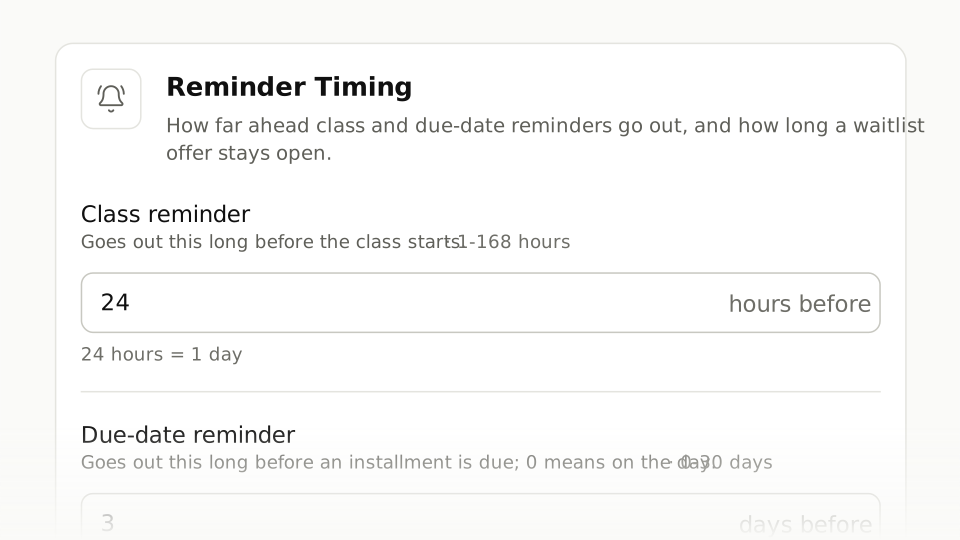
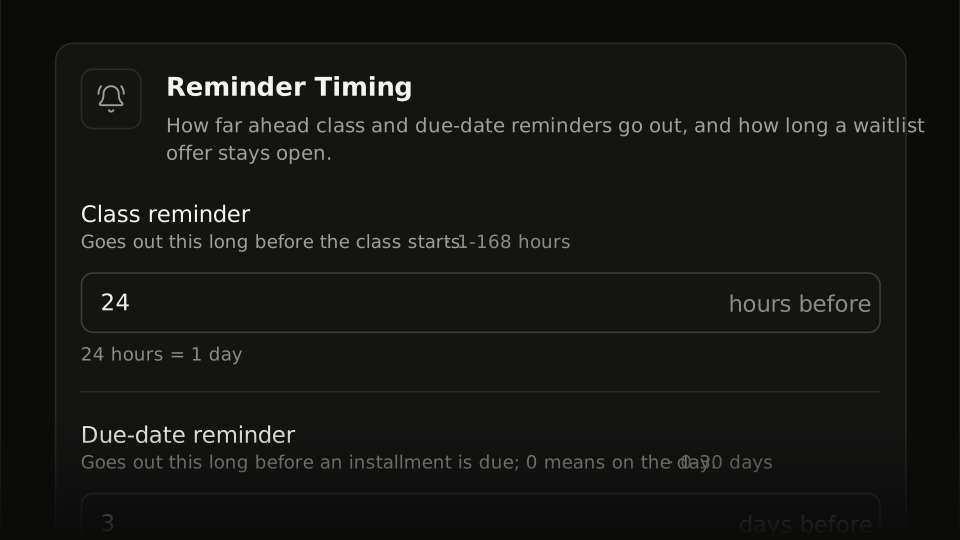
In Dakik reminders go out on their own; the studio’s part is choosing the timings and the channels. Settings decide how many hours before class the reminder goes, how long a member has to take a place that opens on the waitlist, and how many days ahead an installment due date is flagged. Push and WhatsApp are switched on separately for each notification type, and every text can be edited for the studio.
Link the WhatsApp line
Scan the QR code in settings with the studio’s phone; messages then go from the studio’s own number.
Choose the reminder lead time
The class reminder can go anywhere from 1 to 168 hours ahead, 24 by default; keep it a little longer than the cancellation window.
Choose the waitlist window
A member gets between 5 minutes and 24 hours to take an open place, two hours by default; when it lapses, the place moves down the line.
Set the channels and the wording
Switch push and WhatsApp on separately for each notification type and write the text in the studio’s voice; in-app notifications are always on.
The package rules that set the cancellation window: Make-up Pool and Freeze
Frequently asked questions
Do WhatsApp reminders go out from the studio’s own number?
Yes. In Dakik the studio links its WhatsApp line by scanning the QR code in settings with its own phone, and reminders are sent from that number. Members get the message from a number they know, and when they reply the conversation stays on the studio’s own line. Until a line is linked the WhatsApp channel stays off; in-app notifications go out regardless.
Is a push notification or a WhatsApp message better?
Neither replaces the other; they work together. A push notification only reaches members who have added the app to their phone and allowed notifications, while WhatsApp reaches every member with a number on file. In Dakik push and WhatsApp are switched on or off separately for each notification type, and in-app notifications are always on.
Can you choose how many hours before class the reminder goes out?
Yes. In Dakik the studio sets in its settings how many hours before a class the reminder is sent, anywhere from one hour to a week, with 24 hours as the default. Keeping it a little longer than the cancellation window means a member who reads it and cannot come can still cancel inside the rule.
Can a studio change the wording of its reminder message?
Yes. In Dakik the text of every notification type can be edited for the studio, and variables such as the member’s name, class name, date, time, instructor and room fill themselves in. Members who use the app in English can get a separate English text; without one, the Turkish text is sent. Leading with the class name and time makes the message readable from the notification alone.
Are installment payment reminders sent to members automatically?
Yes. Dakik notifies the member, the Owner and the Admins when an installment is coming due; the studio chooses how many days ahead, from 0 to 30, with three days as the default. An overdue installment is reported only to the Owner and Admins, not to the member, so the studio decides how the late payment is raised with them.