What should a written cancellation policy cover?
A policy settles in advance everything that would otherwise be argued at the moment of canceling: the cancellation window, how often members may cancel, late cancellations, no-shows, make-up credits, freezing and the studio's own cancellations. If one of these is not written down, the gap gets filled by negotiation each time and two members in the same situation get different outcomes. The point is predictability, not punishment.
- Cancellation window
- How many hours before class a member can cancel.
- Cancellation frequency
- How many times a week, or over the package, that right can be used.
- Late cancellation
- What a cancellation after the window has closed counts as.
- No-show
- What happens to the credit of a member who does not come.
- Make-up
- Whether a canceled credit comes back, and for how long it can be used.
- Freezing
- How many times, and for how many days, a package can be frozen.
- Studio cancellation
- How the member's credit is protected when the studio cancels a class.
This is a list of how things work, not a legal text. Membership terms, refunds and personal data are a separate matter and should be written with an expert.
How do you choose the cancellation window?
Choose it by how long you need to give a freed place to someone else. In a morning or evening class with a full waitlist a few hours is enough, while a one-to-one session needs a day's notice so the instructor can replan. The window can differ by kind of class; what matters is that each package has one, and that it is written down.
- Where the waitlist is full a short window is enough: the freed place goes straight to someone else
- Where the waitlist is empty the window grows: filling the place takes time
- Private and duo sessions usually have the longest window: a cancellation empties the instructor's hour
- For the first class of the morning consider a window that covers the evening before: a cancellation sent overnight goes unseen
- Whatever the window, write it in hours: "24 hours before" rather than "the day before"
How do cancellation terms differ between packages, by example?
Each package carries terms that suit its own risk. For example: a group package with 12 hours' notice and one cancellation a week, a private package with 24 hours and three cancellations over the whole package, and a trial class where the member cannot cancel but can move to another session. Writing terms per package rather than one studio rule reflects what each kind of class really costs.
| Package | Window | Frequency | Canceled credit | Freezing |
|---|---|---|---|---|
| Group, 8 classes / 30 days | 12 hours | 1 a week | To the make-up pool or another session | Once, up to 14 days |
| Private, 10 sessions / 60 days | 24 hours | 3 over the package | Moved to another session only | Once, up to 30 days |
| Trial, 1 class | 6 hours | 1 over the package | Moved to another session only | None |
In this example a group member can drop one class a week up to 12 hours ahead, and the credit waits in the make-up pool. A private client cancels less often and earlier, because a freed hour cannot be sold to anyone else. Someone on a trial class does not lose it, but can only move it to another day.
The hours and counts in the table are an example, not a recommendation. Choose your own values by looking at how full your waitlists are and at your instructors' timetables.
How does a policy tell a late cancellation from a no-show?
In a late cancellation the member tells you after the window has closed; in a no-show they do not tell you at all. Write the two separately: a late cancellation breaks the rule even if the place could be filled, and a no-show means the class credit counts as used. When both outcomes are spelled out, the conversation rests on the rule rather than on the person.
- Cancellation inside the rule
- The member cancels before the window closes and within their limit. The credit comes back or moves, as the package's make-up policy says.
- Late cancellation
- The member tells you after the window has closed. It is outside the rule; the credit does not come back, and only the Owner or an Admin can make an exception.
- No-show
- The member does not come and does not tell you. The credit counts as used, because the place was held for them.
- Cancellation over the limit
- It is inside the window, but the weekly or per-package number of cancellations is used up. It counts as outside the rule.
Term: Late cancellation
No-shows and late cancellations: No-Shows and Late Cancellations
What should the policy say when the studio cancels a class?
The member should not pay for a cancellation the studio made. When an instructor is ill, a room is unavailable or a public holiday takes a class off the timetable, the member's credit comes back without any window or frequency limit and stays usable until the package ends. Writing that into the policy also makes it easier to explain why members are held to their own rule.
- An instructor's illness, a room problem or a public holiday is a studio cancellation
- The member's credit comes back regardless of the window and the frequency limit
- The returned credit can be used until the last day of the package
- A studio cancellation is not written to the member's weekly cancellation counter
- The member is told why the class was canceled and what happens to their credit in the same message
Where a canceled credit goes: Make-ups and Freezing
What does a sample cancellation policy look like?
The text below is an example written for a studio selling a group class package; change the hours, counts and durations to match your own packages and use it. Each clause states one rule and avoids words like "usually" or "depending on the case" that invite interpretation. It is not a legal text and does not replace your membership terms; it summarizes how they work.
The sample is written for the group package in the table above. Replace the values in square brackets with your own and delete any clause you do not use:
- You can cancel a booking up to [12] hours before the class starts.
- In each calendar week (Monday to Sunday) you can cancel [1] class or move it to another session.
- A class canceled inside the rule comes back to your account as a make-up credit and can be used within [7] days, but not after the last day of your package.
- For cancellations after the deadline and for classes missed without notice, the class credit counts as used.
- You can freeze your package [1] time during its validity, for up to [14] days; its end date moves on by the days you froze it.
- Credits for classes canceled by the studio are returned without any time or count limit and can be used until the last day of your package.
- These are the rules in force on the date you bought your package; later changes do not affect it.
The text summarizes how things work; it is not a contract clause. Get legal support for the clauses on refunds, withdrawal and personal data.
How do you announce a cancellation policy to members?
A policy is not announced once; it is visible wherever the member makes a decision. It is explained with the package at the point of sale, written on the booking screen, and any change is announced in advance with the date it takes effect. A member learning the rule the first day they break it is a failure of the announcement, not of the policy, and most arguments start there.
Settle the terms of each package
Write down the window, the frequency, the make-up policy and the freezing right of each package one by one.
Set the date it takes effect
Choose the date after which packages are sold under the new rule, and say that existing packages carry on under the old one.
Announce it in advance
Send all members a short message at least a few weeks before it takes effect, and keep a printed copy at the front desk.
Explain it at the point of sale
When selling a new package, tell the member the window and the weekly allowance in one sentence, so nobody learns the rule the first time they cancel.
How does Dakik apply a cancellation policy per package?
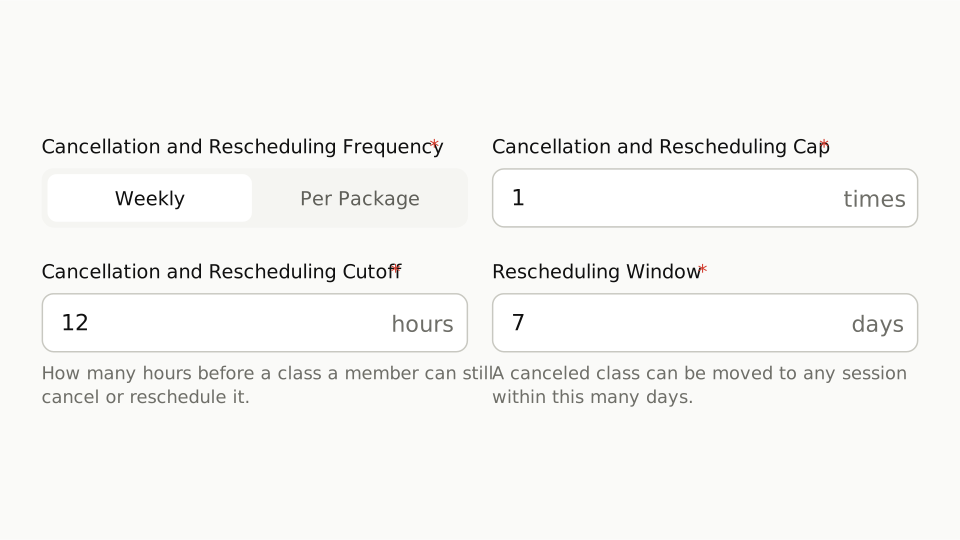
In Dakik the cancellation policy is written into the package definition: the make-up policy, the cancellation window, the cancellation frequency and its limit, the reschedule window and the right to freeze. When the package is sold these terms are copied onto the member's package. When a member cancels from their own panel, the app checks the window and the counter and refuses a cancellation that is too late or over the limit.
- Make-up policy: the member cannot cancel; can only move the class to another session; or can send it to the make-up pool or move it
- Cancellation and rescheduling cutoff: from 0 to 720 hours, set in hours
- Cancellation frequency: per calendar week starting Monday or over the whole package, with a limit from 1 to 100
- Rescheduling window: how many days a canceled credit stays usable (1 to 365), never past the last day of the package
- Freezing right: from 1 to 12 times, each freeze up to between 1 and 365 days
- Terms are copied onto the member's package when it is sold; editing the definition later does not change packages already sold
- When the studio cancels a session, its bookings skip the counter and their held credits go straight back to the package
How the package rules work: Make-up Pool and Freeze
Frequently asked questions
If the policy changes, do existing packages change too?
They should not: a member uses a package on the terms it was bought under. In Dakik, editing a package definition does not touch the terms already copied onto packages that were sold; the new rule applies only to packages sold from then on. Saying that clearly when you announce the change settles existing members' worries from the start.
Should you make an exception for a cancellation outside the rule?
Real exceptions happen, such as illness or an emergency, but the policy should also say who makes the exception and how. In Dakik a member cannot make a late cancellation from their own panel; only the Owner or an Admin can open one, and only by writing a reason. Because that reason stays on record, an exception does not quietly become the rule.
Do private sessions need a separate cancellation policy?
For most studios, yes. In a group class a freed place can be filled from the waitlist; in a private session a canceled hour is an empty hour for the instructor. That is why private packages usually have a longer window and fewer cancellations. When the rule is written per package, group and private classes live side by side in one studio on different terms.
Should a cancellation policy also cover refunds of the package price?
Canceling a class and refunding a package are separate matters and should be written separately. This guide covers only how class credits work. Whether an unused package is refunded depends on your membership terms and the consumer rules that apply to you, so it is wise to involve a legal adviser when you write that clause.
On which day does a weekly cancellation allowance reset?
In Dakik the weekly limit counts by the calendar week starting on Monday, and a cancellation is taken from the allowance of the week the class falls in. The limit can also be set over the whole package; then the counter never resets and counts every cancellation until the package ends. Stating which count applies in the policy prevents end-of-month disputes.