How does a Credit package work?
A Credit package defines two things: how many class credits it grants and the date by which they have to be used. One credit is held the moment a member takes a seat in a session and used once the class is held. On a cancellation inside the rule that credit is not lost - it returns to the Make-up Pool and the member spends it on another session.
- The number of class credits and the validity date are set in the package definition
- A booking holds one credit; it is used once attendance is taken or the class takes place
- On a cancellation inside the rule the credit returns to the Make-up Pool
When is a Duration package the right choice?
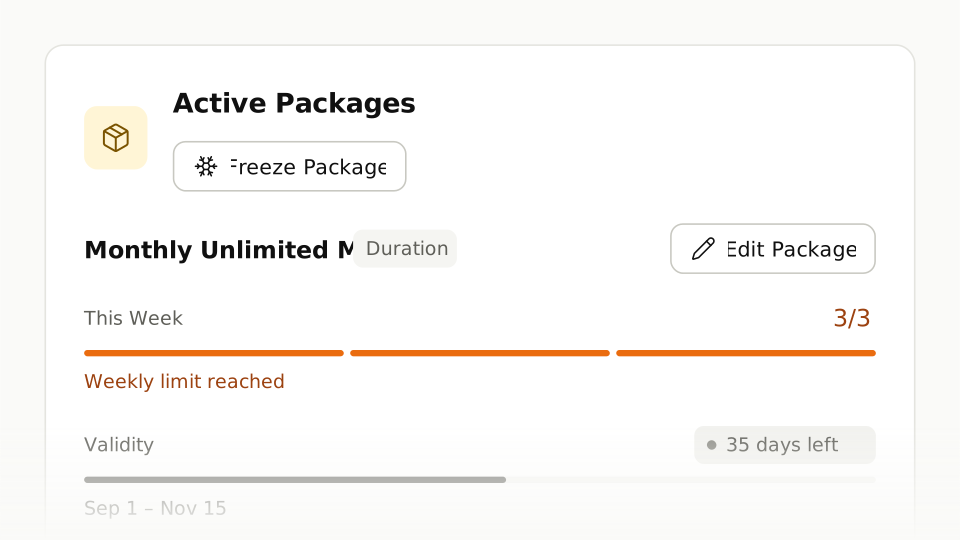
A Duration package is right when you sell a period rather than a number of classes: no class credit comes off while it is valid. You may set a weekly class limit, and leaving that field empty means no limit at all for the whole period. Studios that work on a monthly-subscription footing use this type.
- No class credit comes off while the package is valid
- The weekly class limit is optional; left empty, there is no limit
- The weekly limit counts per calendar week starting on Monday
Because a Duration package counts no credits, Dakik works out its class value itself: the pay of an instructor on a revenue share is calculated from what one class of the package is worth. The package price is divided by the weeks it runs times its weekly class limit, counting one class a week when there is no limit. On a Credit or Trial package the class value falls out on its own, as the price divided by the credits.
How many times can a Trial package be defined?
A Trial package can be defined for a member only once, and the application keeps track of it: a second trial cannot be created. Its credits behave like a Credit package: held at booking, used once attendance is taken or the class takes place. It also does work on the sales side, because it stops a member who has had their first class from buying trial-priced classes again.
Which classes can a class package be used for?
A package works only in the classes chosen in its definition: a package sold for group reformer cannot be used in a mat class unless mat is added to its scope. The class type has to match as well; a group package does not cover a private or duo class. When a member holds several suitable packages, a make-up credit that fits the session is spent first, otherwise the package that ends soonest pays.
- Scope: the classes a package is valid for are picked one by one in its definition
- Class type: group, private and duo packages do not stand in for one another
- Order: a make-up credit that fits the session first, then the package that ends soonest
- A package cannot be used in a class outside its scope; booking flags it at once
Setting the scope with care protects the price. If reformer costs more than mat, defining a package for each, or selling a higher-priced combined package that covers both, stops a member from taking the dearer class on the cheaper package. Spending the package that ends soonest first also keeps the credit closest to expiring from going to waste.
When exactly does a class credit come off?
A booking holds the credit; it leaves the package once attendance marks the member Attended or No-show, or once the class takes place. A held credit cannot be spent twice, so a member cannot book more classes than they have credits. A member who reserved a seat and did not turn up has still spent the credit, because the studio could not sell that seat to anyone else.
- Booking: a credit is held for the class
- Cancellation inside the rule: the credit returns to the pool
- Attendance or the class taking place: the held credit is used; attendance also feeds the pay calculation
- Duration package: no credit comes off, the seat counts against the weekly limit
Setting up the schedule and booking: Schedule and Booking
How is the cancellation and rescheduling rule set?
The rule lives in the package definition, not in a verbal understanding with the member. Three things are set: how many hours before the class it may be canceled, how often that may be done, and what happens to the credit. The member cancels inside the rule from their own panel; only the Owner or an Admin can open an exception.
| Setting | What it decides | Example |
|---|---|---|
| Cancellation window | How many hours before the class it may be canceled | 12 hours |
| Cancellation frequency | How often that may be done, per week or over the package | Once a week |
| Make-up permission | What happens to the canceled credit | Poolable |
Make-up permission options
- No Make-up Credit
- A canceled class credit does not come back. Studios with a fixed schedule and a guaranteed seat choose this.
- Reschedulable
- The member may move the class to another session, but the credit never enters the pool: it attaches to the new session as it moves.
- Poolable and Reschedulable
- The credit returns to the Make-up Pool and the member spends it on a session that suits them later. The most flexible option.
Only the Owner or an Admin can approve a request outside the rule, by writing down a reason - so an exception is a recorded decision rather than a favor.
How does freezing a package affect its end date?
A package can be frozen for as long as its own definition allows, and the end date moves out by the length of the freeze - so a member on holiday does not watch their package melt. A studio-side cancellation is a separate case: when a room or an instructor is blocked, the held credit goes straight back to the package, whatever the frequency rule says.
- The freeze allowance is set in the package definition
- The end date moves out by the length of the freeze
- On a studio-side cancellation the held credit goes straight back to the package
What is the "Awaiting Package" record for?
You can add a member whose package is not defined yet to a recurring series; their record in its sessions sits as "Awaiting Package". The moment a package is defined those records turn into bookings on their own and a credit is held for each class. Writing a member whose payment will come later into the schedule is safer than noting it down on the side.
- A member with no package can be added to a recurring series
- Once a package is defined the record turns into a booking on its own
- A credit is held the moment it becomes a booking
For a member who attends on an Awaiting Package record, the credit comes off the first suitable package after the fact, once one is defined. For a member who does not turn up on such a record, there is no credit left to take.
How does an 8-class package play out over 30 days?
Take an example: a Credit package with 8 class credits, 30 days of validity, a 12-hour cancellation window, one cancellation a week and the make-up permission switched on. A booking holds a credit that is used once the class is held, a cancellation inside the rule adds a make-up credit to the pool, and a no-show or a cancellation past the window brings nothing back. Whatever is left when the validity ends is lost.
| Day | What happened | Credits left | Make-up pool |
|---|---|---|---|
| 1 | The package is sold | 8 | 0 |
| 2 | Seats are booked in the Tuesday and Thursday classes | 6 | 0 |
| 3 | The Thursday class is canceled 20 hours ahead (inside the rule) | 6 | 1 |
| 5 | A seat in the Saturday class is booked with the make-up credit | 6 | 0 |
| 9 | A seat is booked and the member does not turn up | 5 | 0 |
| 16 | A seat is booked; a cancellation is asked for 3 hours ahead, past the window | 4 | 0 |
| 17-27 | Three more classes are booked | 1 | 0 |
| 31 | The validity ends and the unused credit is lost | 0 | 0 |
The days and figures in the table are example values chosen to show how the rules work. Your own package length, cancellation window and limits may differ; the mechanics stay the same.
How are member packages and class credits tracked in Dakik?
In Dakik a package is defined once: its type, its credits or weekly limit, its validity, the classes it covers and its cancellation, make-up and freeze rules. When it is sold to a member those terms are copied onto the member package and survive any later edit of the definition. The member sees the credits left, this week's usage and the expiry of each make-up credit in their own panel.
- A Credit package holds 1 to 500 credits; any package is valid for up to 730 days
- A Duration package takes a weekly limit of 1 to 50 classes, or none at all
- A cancellation window of 0 to 720 hours, the frequency counted per week or per package
- A freeze allowance of 1 to 12 freezes, each up to 365 days
- A definition that has been sold is not deleted but set to passive
On the features page: Member Packages
Frequently asked questions
Do unused class credits expire at the end of a pilates package?
Yes. Credits are tied to the package's validity date, and once it passes the remaining credits can no longer be used; the package counts as expired. Credits in the Make-up Pool end on its last day at the latest. For a member pausing for a holiday or an injury, freezing the package before it runs out is what saves the credits.
If I change a package price, are packages already sold affected?
No. A change to the package definition applies only to packages sold from then on; a package already sold to a member keeps the credit count, cancellation rule and freeze allowance it had at the moment of sale. To take a package off sale, set it to passive: new members are no longer offered it, but those who bought it keep using it.
How many classes should a pilates studio package include?
The common structure is a monthly package built on how often a member comes each week: 4 classes for once a week, 8 for twice, 12 for three times. The more classes a package holds, the longer its validity has to be. In Dakik a Credit package can hold 1 to 500 class credits and stay valid for up to 730 days.
Can a class package be sold in installments?
Yes. When a package is sold, the part of the price not collected is recorded as the member's debt and can be split into 2, 3, 6 or 12 installments; the whole amount can also be taken at once. The package's paid, partly paid or unpaid status is worked out from the payments, so nobody keeps a separate table of who still owes what.
Can a free trial class be set up as a package?
Yes. A package price can be set to 0 TL, so a free trial class is a Trial package with, for example, a single class credit. Because a Trial package can be given to a member only once, the same person cannot sign up for a second free class. After the trial the member moves on to a regular Credit or Duration package.