What work should studio software take over?
Four jobs: tracking members' packages and class credits, running the schedule without room or instructor clashes, calculating instructor pay from attendance, and showing the studio's cash flow in one place. Without those four a system is a ledger; with them the end-of-month job falls from hours to minutes.
These four are the jobs that take the most time in a studio; a system's worth is measured by how much of them it takes over.
Where does tracking a studio in a spreadsheet break?
A spreadsheet calculates but it does not enforce. A last-minute cancellation is lost among the messages, the remaining credit becomes something to argue about, make-up and freeze rules break when a formula does, and end-of-month bonuses are worked out by hand. The breaking point is always the same: one member's information sits in four places.
- Cancellations lost in the WhatsApp group
- A last-minute cancellation gets buried between messages; the late-cancellation rule goes unapplied, the spot stays empty and the income is gone.
- Package credits written into a notebook
- How many classes are left turns into an argument between the member and the studio; every credit deducted wrongly costs both trust and revenue.
- Make-up and freeze rules tracked in a spreadsheet
- Who has how many make-up credits, and which package was frozen when? Once the formula breaks, so does the rule.
- Pay worked out by hand, cash flow in a muddle
- Instructor pay takes hours at the end of the month, installments get forgotten, and the money in the drawer gets mixed up with profit.
A spreadsheet, a WhatsApp group or studio software?
Each solves a different problem. A spreadsheet keeps records but enforces no rule; a WhatsApp group makes announcements but does not count places; studio software joins the booking, the class credit and the cancellation rule in one record. For a studio with one instructor and few rules the first two can be enough; as rules and instructors multiply, the work done by hand between them becomes the work software takes over.
| Criterion | Spreadsheet or notebook | WhatsApp group | Studio software |
|---|---|---|---|
| Credits left | Taken off by hand; a formula can break | Not tracked | Taken off on booking |
| Places in a session | Counted on a separate sheet | Counted from messages | Shown per session |
| Late cancellation | Rule applied by hand | The message can get lost | Handled by the package rule |
| A place that frees up | Nobody hears about it | Posted to the group again | Offered to the next member on the waitlist |
| Class reminder | None | Written by hand | Sent on its own |
| Instructor pay | Worked out by hand at month end | Not calculated | Calculated from attendance |
| What the member can see | Nothing; they ask | Nothing; they ask | Their credits and bookings |
| Personal data | Spreads as the file is copied | Members see each other’s numbers | Access limited by role |
| Direct cost | None | None | A monthly or yearly subscription |
The table compares how each method works in general, not a particular product. A spreadsheet and a group look free, but the work by hand on every row is your hours or your team’s; when you weigh up software, test each row with your own data during the trial.
When does booking through a WhatsApp group stop being enough?
A group is enough while booking needs no rules: few members, fixed times and cancellations that cause no trouble. Once more people sign up for a session than it holds, cancellations sent at night leave empty places in the morning, and "how many classes do I have left" arrives every week, the group is no longer a booking system and you are the one counting every place.
- More people sign up for a session than it holds, and you decide who gets in
- A place freed by a cancellation sent at night stays empty, announced to nobody
- "How many classes do I have left?" is asked several times a week
- A message was missed and a member turned up to find no place
- A screenshot of the group is being used as the record
If even two of these show up regularly, the problem is not the group but using it for bookings. The group can stay for news and chat; bookings and places move into a system.
Which rules should live in the software and which in a person?
Every rule that repeats and can be counted should live in the software: the cancellation window, the cancellation frequency, the make-up permission, the freeze allowance, the weekly class limit. What should stay with a person is the exception - approving a request outside the rule, with a reason. Software that records an exception is good; software that turns exceptions into the rule is not.
- Cancellation window and frequency: in the software
- Make-up permission and freeze allowance: in the software
- Weekly class limit: in the software
- Approving a request outside the rule: with a person, and with a reason
| Rule | Example value | Who applies it |
|---|---|---|
| Credits | 8 classes | The software |
| Validity | 45 days | The software |
| Cancellation window | Up to 12 hours before class | The software |
| Cancellation frequency | At most 2 a week | The software |
| Make-up permission | Yes; a canceled class can be rebooked | The software |
| Freeze allowance | Once, up to 14 days | The software |
| Canceling outside the rule (e.g. illness) | Case by case | The Owner or an Admin, with a reason |
Why does the active member count set the price?
Because what a studio gets out of a system grows with the number of members it tracks: a studio with fifty members has a smaller job, and should have a smaller bill, than one with a hundred and fifty. Tying the price to the member count is what keeps a small studio from carrying a large studio's cost.
- The active member count is the members who hold a running package and are not inactive, totaled across all of the business's branches
- The tier follows the active member and branch counts; only Pro adds the WhatsApp Assistant
- No active member limit applies during the trial
What should you look at during the trial?
Try it with your own data, not with the demo set. Move your existing members across, define a package you actually sell, build one week of the schedule, and have one instructor's pay calculated on their real terms. A trial is not for testing the product; it is for testing how your own studio sits inside it.
Move your members across
Bring your existing member list and their packages over; where the move gets stuck tells you a lot.
Define a package you actually sell
Build the real thing: the number of credits, the period, the cancellation rule and the make-up permission.
Build one week of the schedule
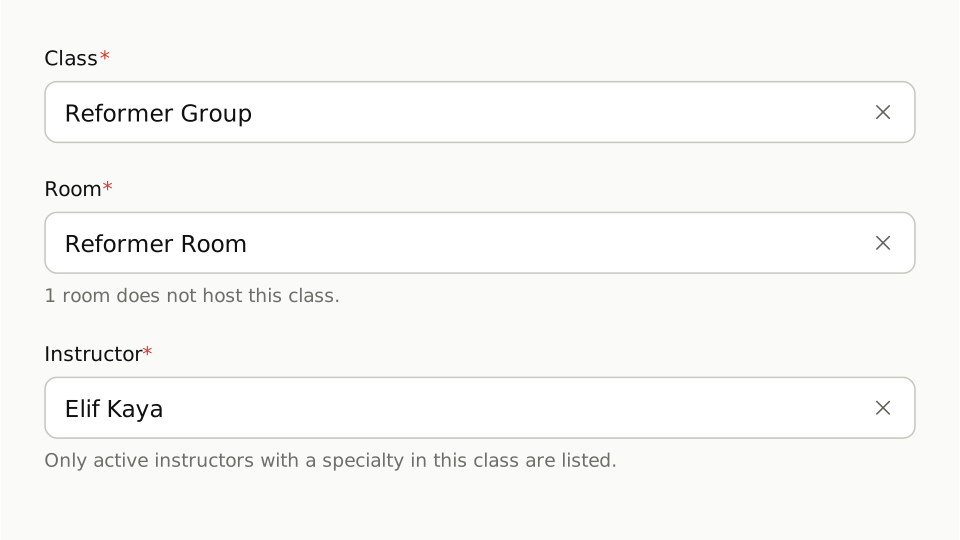
Enter the sessions, the rooms and the instructors, and see where the clash check warns you.
Have one instructor's pay calculated
Define an instructor on their real terms and compare the figure that comes out of attendance with your own.
Run the cash side for a week
Enter income, expenses and installment debts, and check the profit-and-loss gives the figure you already know.
At the end of the trial one question tells you most of it: did you have to go back to the spreadsheet or the group this week to check a number? If you did, what you went back for is the work the software has not taken over; put it on your checklist.
What questions should you ask before deciding?
Choosing software is not ticking off a feature list; it is getting a few concrete questions answered. The list below comes from the points studios regret at the end of a trial. Every one of them can be answered inside the trial period, and every one left uncertain stays yours after the contract.
- Can I move my existing members and their remaining credits across?
- Can it apply my cancellation and make-up rule without me stepping in?
- Does instructor pay come out of attendance on its own?
- Can a member handle their own cancellation and make-up?
- Does the price rise predictably as my member count grows?
- Can I export my data?
The step after the decision: Moving from Spreadsheets
How does Dakik take over those four jobs?
In Dakik a package definition carries the credits, the period, the cancellation window, the cancellation frequency, the make-up permission and the freeze allowance together, and a credit is held at booking and used once the class is held. The schedule flags room and instructor clashes before you save, pay is calculated monthly from attendance, and income, expenses and installments sit in one place by till. Members cancel and book make-ups from their own panel.
- Packages and class credits
- Credit, Duration and Trial packages; a credit is held on booking, used once attendance is taken or the class takes place, and returns to the Make-up Pool on a cancellation inside the rule.
- Schedule and clashes
- Room and instructor clashes, blocked hours included, are flagged before a session is saved.
- Instructor pay
- Monthly Fixed, Weekly Fixed, Per Class, Per Participant and Revenue Share models; the figure comes out of attendance.
- Finance
- Till-based income and expenses, installment tracking, monthly and yearly profit and loss, and CSV export.
How package and cancellation rules work: Member Packages
Frequently asked questions
Can you try studio software for free?
Yes; Dakik gives every studio a free trial with every feature on, no credit card and no active member limit, so you can bring your whole member list across and run a real week. If you do not pick a tier at the end, access stops, but nothing you entered is deleted and you carry on where you left off.
How many members should a studio have before it needs software?
The deciding number is not members but rules. A small studio with one instructor and fixed packages can manage with a notebook; once cancellation and make-up rules, several instructors or month-end pay come in, the spreadsheet needs fixing by hand every week. When the credits a member has left become something to argue about, it is time to move.
Can studio software be used from a phone?
Yes; Dakik is a web app that runs in the browser (a PWA), so managers and members alike use it from their phones with nothing to download from an app store. Added to the home screen it opens like an app, and class reminders arrive as push notifications. While choosing, try the member screens on your own phone to see what your members will see.
Does studio software collect payments from members?
It varies between systems, so ask before you decide. Dakik does not take card payments or invoice your members; you record each cash, bank transfer or card terminal payment against its till, and a remaining balance can be split into tracked installments. That is enough if collection stays as it is; if online payment is a must, put it on your checklist.
Can a studio with several branches run them all from one system?
Yes; in Dakik branches are managed under one sign-in and you switch between them without changing accounts. How many branches you can open depends on the tier, and the active member limit counts every branch together, not one. While choosing, also test during the trial whether a member can join a class at another branch under your own rules.