What counts as a register in a studio?
A register is wherever the money actually sits: the cash drawer, the bank account, the card terminal and any online payment provider. Every collection lands in one and every payment leaves one. Keeping them apart ends the month-end hunt for how much you have, because you see the spread rather than a single total.
- Cash
- Money physically in the studio; countable at the end of a day.
- Bank
- The account transfers and standing orders arrive in.
- Card terminal
- Card takings, delayed by however long settlement takes.
- Online payments
- Amounts held at the provider and paid across on a cycle.
When does a collection count as income?
For cash flow, a collection counts on the day the money reaches a register. On an installment plan each installment counts on its own date, and a class paid for at the door counts that day. A package you have not collected on is a receivable, not income; adding the two together is the easiest way to show money you do not have.
- A collection is recorded on the day the money reaches a register
- On an installment plan, each installment counts on its own date
- An amount not yet collected is a receivable, not income
- A refund leaves the register it arrived in rather than reducing income
For example, if a 12,000 TL package is sold in three equal installments, 4,000 TL reaches the register in the month of sale. The remaining 8,000 TL is not that month’s income; it waits in the list of outstanding installments as a receivable with its due dates, and each installment counts as income in the month it is paid.
How is revenue from a package sold up front recorded?
Both views are correct, but they answer different questions. On a cash basis a three-month package lands once, in the month it sold. Across the term the same package is divided into three, and each month carries its share. Use the first to plan cash, and the second to see what the studio genuinely earned.
| View | When revenue is recorded | What it answers |
|---|---|---|
| Cash basis | Once, in the month it sold | What came in this month |
| Across the term | Divided across three months | What was really earned this month |
| Receivable | Not yet arrived | What is still to be collected |
For example, a three-month package sold for 9,000 TL up front in September is recorded on a cash basis as a single 9,000 TL line in September. Across the term the same package puts 3,000 TL into each of September, October and November; even if nothing reaches the register in October, the studio is still teaching 3,000 TL worth of classes that month.
Which view your formal records are built on is a question for your accountant; the distinction here is for running the business.
How package types are defined: Class Package Rules
Which costs should be tracked separately?
Separate costs by how much they move. Instructor pay moves with the number of classes, rent and subscriptions do not move at all, and equipment and maintenance arrive at irregular intervals. Keep those three apart and, in a month when income drops, what can be cut and what cannot is visible at a glance.
- Variable: instructor pay, which moves with the number of classes
- Fixed: rent, subscriptions, insurance - unchanged when takings fall
- Irregular: equipment, maintenance, refits - planned yearly, not monthly
- Kept apart, they show what can be cut in a hard month and what cannot
| Category | Behavior | What it means |
|---|---|---|
| Staff Payout | Variable | Moves with the number of classes and attendance |
| Rent | Fixed | Stays the same when takings fall |
| Utilities/Dues | Fixed | Moves a little with the season but cannot be cut |
| Materials/Supplies | Variable | Rises with classes and members |
| Products/Inventory | Variable | Moves with the products sold |
| Marketing/Advertising | Adjustable | The first line reviewed in a hard month |
| Maintenance/Repairs | Irregular | Needs a yearly plan and money set aside |
| Taxes/Government Fees | Periodic | Due dates are known, so it can be set aside early |
| Software/Technology/Subscriptions | Fixed | A monthly or yearly subscription |
| Other | Varies | If it grows, look at what is landing in it |
How does instructor pay become a cost?
Pay is calculated from attendance, but it becomes a cost when it is paid. Classes taught during the month grow the amount owed; paying it takes money out of a register. The gap between the two is the unpaid balance, and that is the figure month end has to show: work already earned and not yet paid is money the studio owes.
- Pay is calculated from attendance and becomes a cost when paid
- The gap between calculated and paid is the unpaid balance
- That balance is money the studio owes and belongs in the cash plan
- A bonus is added to the pay and shows in the same month
How instructor pay is calculated: Instructor Pay Models
What does closing the month involve?
Closing is a reading rather than a calculation: if attendance was taken, the pay is already worked out, and if collections were entered, the income is already added up. The work at month end is finishing any missing attendance, looking at the unpaid balance, and checking whether the cash on hand covers next month’s fixed costs.
Finish the missing attendance
A session with no attendance taken never reaches instructor pay; close those first.
Read the registers and the balance
Look at what went in and out of each register alongside the unpaid pay balance.
Look at next month’s fixed costs
Know before the month starts whether the cash on hand covers rent and subscriptions.
What does a studio’s monthly income and expense sheet look like?
A monthly sheet has three parts: income that reached a register, costs that left one, and the difference, which is net cash. Under it sit two information lines: installments members have not paid yet and instructor pay not yet paid out. Neither is added to cash, but they show how much of the net is really free; in the example below, 8,000 TL of a 46,000 TL net is owed to instructors.
| Line | Amount | What it is |
|---|---|---|
| Member payments | 182,000 TL | Package sales and installments paid that month |
| Other income | 6,000 TL | Takings outside memberships, such as product sales |
| Total income | 188,000 TL | Money that reached the registers during the month |
| Staff Payout | 72,000 TL | Payments made to instructors that month |
| Rent | 45,000 TL | Fixed |
| Utilities/Dues | 9,500 TL | Fixed |
| Marketing/Advertising | 8,000 TL | Adjustable |
| Maintenance/Repairs | 4,000 TL | Irregular |
| Software/Technology/Subscriptions | 3,500 TL | Fixed |
| Total costs | 142,000 TL | Money that left the registers during the month |
| Net cash | 46,000 TL | Total income minus total costs |
| Outstanding installments | 36,000 TL | Information line: a receivable, not added to cash |
| Unpaid instructor pay | 8,000 TL | Information line: owed, not yet paid out |
Reading it: 8,000 TL of the 46,000 TL net is owed to instructors, so the free cash is 38,000 TL. The 36,000 TL in installments is not in a register yet; it enters the cash plan of the coming months on its due dates.
How do you work out a studio’s break-even point?
The break-even point is how many attendances a month it takes to cover the fixed costs. Start with the average class value of one attendance and take off what goes to the instructor; what remains is the contribution per attendance. Divide the monthly fixed costs by that contribution and the result is the fewest attendances the studio needs to avoid a loss. Every attendance above it is profit.
Add up the fixed costs
Rent, utilities, subscriptions, marketing and maintenance: 70,000 TL a month in the example.
Find the contribution per attendance
With an average class value of 500 TL and 200 TL going to the instructor, each attendance leaves 300 TL.
Divide the fixed costs by it
70,000 ÷ 300 = 233.3, so the studio needs at least 234 attendances a month.
Turn it into classes
If classes average five members, that is roughly 47 classes a month.
If an instructor is on a fixed salary, the salary counts as a fixed cost rather than as a share per attendance: the contribution grows, but so do the fixed costs it has to cover.
How do you track a studio’s income and costs in Dakik?
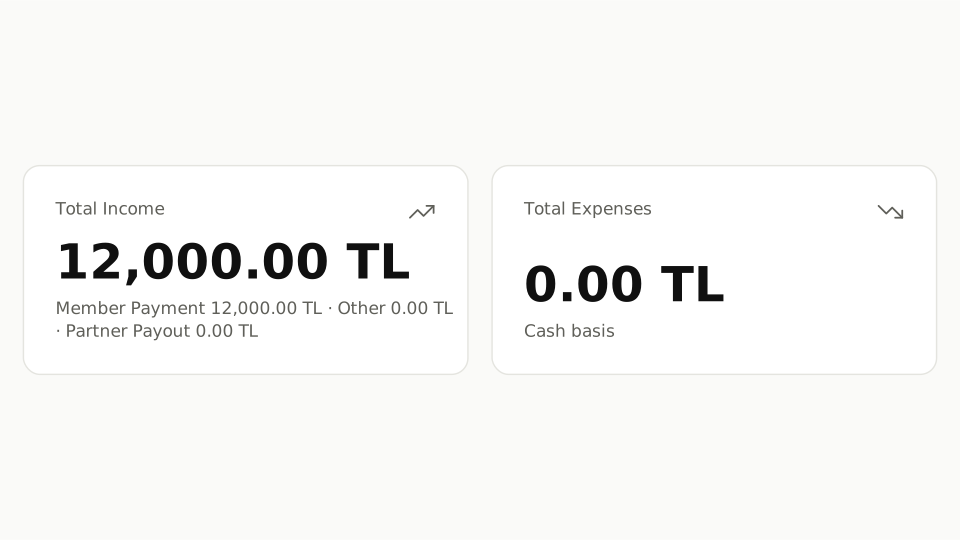
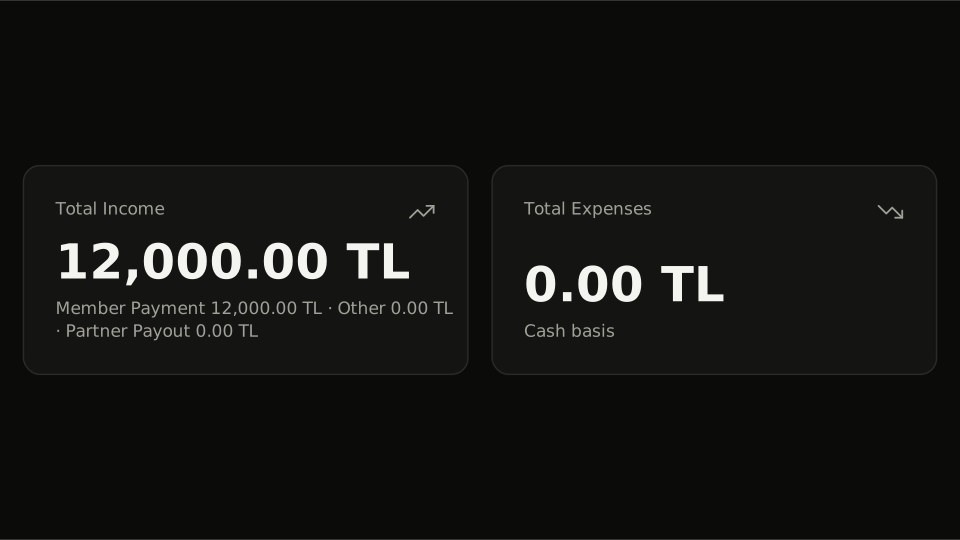
Dakik’s finance summary is cash-based: every record falls in the month of its payment date, and the month’s income, costs and net appear on one screen. Income is split into member payments and other income, costs by category, and instructor payments sit on their own Staff Payout line. Outstanding installments and unpaid instructor pay are shown as separate information lines, never mixed into cash.
- Beside the monthly summary, all twelve months of the year with their income, costs and net in one table
- For every account, such as cash, bank or card terminal, the month’s in, out and balance
- Templates for recurring costs; a record is entered only when the payment is made
- A CSV of income, costs and outstanding installments covering the whole selected period
What the finance screen shows: Finance Summary
Frequently asked questions
How do you track cash and card payments separately?
Every collection records two things: the payment method and the account the money went into. In Dakik the studio defines its own methods, such as cash, card or transfer, and its own accounts, such as the till, bank or card terminal; each account shows its monthly in, out and balance. So the cash in the drawer can be counted at day end without card takings mixed in.
How do you track what is still owed on a package sold in installments?
In an installment sale the package price is split into a payment plan, and each installment joins the list of outstanding debts with its due date. Dakik shows the overdue and upcoming totals separately in that list and reminds the member before an installment falls due. Each installment paid is recorded as income on its own date, in the account it went into.
Are recurring costs such as rent recorded automatically every month?
No. In Dakik a recurring cost is kept as a template that prefills the new-expense form, but the record is only entered when the payment is made. That way unpaid rent never looks as if it has left the account; cash flow shows only payments actually made, and the month-end figure matches the money in the account.
How do you hand income and expense records to your accountant?
The most practical way is a monthly export. In Dakik incomes, expenses and outstanding installments download as a CSV file with the filters on screen applied, and the file holds the whole selected period rather than just the visible page. How the records go into the formal books is your accountant’s call; the studio’s job is keeping them complete and up to date.
How do you correct a payment that was entered wrongly?
If the amount or the account is wrong, edit the record; if the payment never happened, the record is not deleted but canceled with a reason. A canceled record stays in the list with its status but no longer counts toward totals or account balances. That trail means that when you ask at month end why a figure changed, the answer is on record.