What is instructor pay calculated from?
The input is attendance, not the schedule. A class that was planned but not held does not enter the calculation; a class that was held enters it together with how many members attended. So the work at the end of the month is a reading rather than a calculation: if attendance was taken, the figure is already there.
- The input is attendance: a class not held does not enter the calculation
- The number of members who attended is the input of the per-participant models
- A class with no attendance taken raises a missing-attendance warning
Which of the five models fits which case?
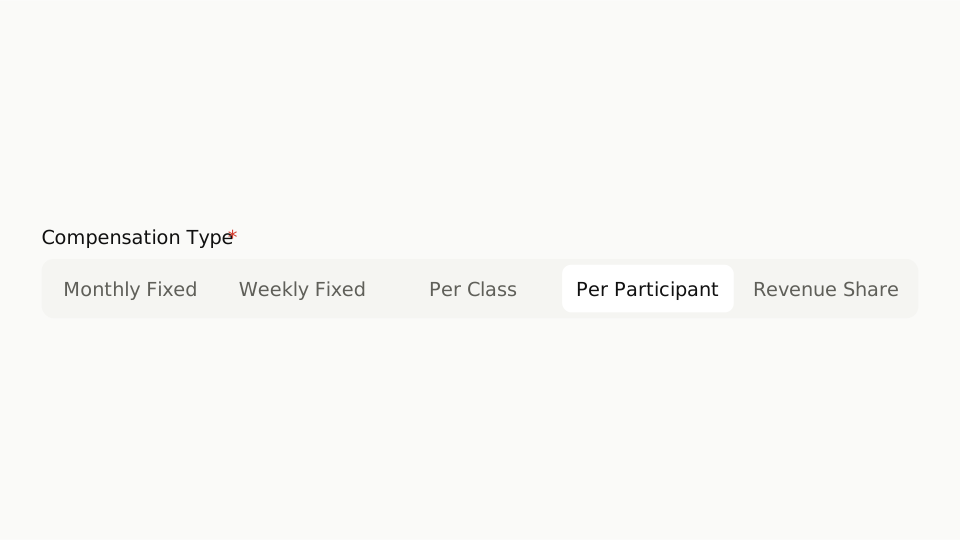
The model describes the relationship you have with the instructor. Fixed models keep the risk with the studio and give the instructor a predictable income; per-class and per-participant models share it; a revenue share makes the instructor a partner in how full the room is. Different instructors in one studio can be on different models at the same time.
| Model | Pays on | Field defined | Suits |
|---|---|---|---|
| Monthly Fixed | A fixed amount per month | Salary | An instructor working full time at the studio |
| Weekly Fixed | A fixed amount for every Monday in the month | Salary | An instructor on a fixed weekly schedule |
| Per Class | A fixed amount for every class held | Per-class fee | A cover or off-schedule instructor |
| Per Participant | An amount for every member who attended | Per-participant fee | Group classes the instructor fills |
| Revenue Share | A percentage of revenue | Share percentage | An instructor who brings their own following |
What does a worked example of instructor pay look like?
Running one month through all five models shows the difference most clearly. In the example the instructor teaches 12 classes a month, those classes see 60 attendances in total, and each attendance carries a class value of 500 TL. The terms are chosen so that every model pays 18,000 TL that month; when attendance falls or rises, the fixed and per-class models hold still while per-participant and revenue share move with it.
| Model | Example terms | 36 attendances | 60 attendances | 84 attendances |
|---|---|---|---|---|
| Monthly Fixed | 18,000 TL a month, full month | 18,000 TL | 18,000 TL | 18,000 TL |
| Weekly Fixed | 4,500 TL a week, a four-Monday month | 18,000 TL | 18,000 TL | 18,000 TL |
| Per Class | 1,500 TL per class, 12 classes | 18,000 TL | 18,000 TL | 18,000 TL |
| Per Participant | 300 TL per attendance | 10,800 TL | 18,000 TL | 25,200 TL |
| Revenue Share | 60% of class revenue | 10,800 TL | 18,000 TL | 25,200 TL |
The amounts are an example chosen to compare the models, not market rates. The class value is what one class of an 8-class package priced at 4,000 TL is worth (4,000 ÷ 8 = 500 TL); revenue share is taken from the sum of those values for the members marked as attended. The same Weekly Fixed terms pay 22,500 TL in a month with five Mondays.
Run it with your own numbers: Instructor Pay Calculator
Is a per-class fee or a per-participant fee better?
Average attendance decides it. Divide the per-class fee by the per-participant fee and the result is the break-even attendance. Comparing 1,500 TL per class with 300 TL per participant, the threshold is five members: in classes averaging fewer than five, per-class pay earns the instructor more, and in classes averaging more, per-participant pay does. For the studio the sums run the other way.
- A per-class fee protects the instructor when classes are thin; the studio carries the empty places
- A per-participant fee makes the instructor a partner in filling the class; a thin class cuts their pay too
- Private and duo sessions always have low attendance, so a per-class fee is more predictable there
- If neither fits, combine them: a modest per-class fee with a per-participant bonus on top
How many weeks does a Weekly Fixed month pay?
A Weekly Fixed definition pays once for every Monday in the month - a month with four Mondays counts four weeks, one with five counts five. That settles the "how many weeks is a month" argument: what is counted is the Mondays on the calendar, and every month carries its own number.
What a Weekly Fixed definition counts is the Mondays in the month, which is why some months pay four weeks and others five.
For example, terms of 4,500 TL a week pay 18,000 TL in October 2026, which has four Mondays, and 22,500 TL in November 2026, which has five. Monthly Fixed pays the same salary every month instead; for an instructor who starts or leaves mid-month, the salary is pro-rated by the days worked.
How is a definition that changes mid-month applied?
If an instructor's terms change in the middle of a month, the classes already held are not recalculated against the new definition. Each class is calculated against the definition in force on its own date, so a raise or a cut applies to the classes after it took effect. The month's figure is the sum of two definitions.
For example, if an instructor on 1,500 TL per class moves to 1,800 TL from the 16th, the 6 classes in the first half of the month come to 9,000 TL, the 6 in the second half to 10,800 TL, and the month totals 19,800 TL. The old terms are not deleted; they stay on record with the date they applied from.
How is a bonus added?
A bonus is added as a separate line on top of the model, per class or per participant, in one of two forms: a percentage of the instructor’s own pay (their salary, or their per-class or per-participant fee), or a flat amount. Keeping it apart from the model means removing or changing a bonus does not touch the base terms.
- Percentage
- Added for every class taught or every member who attended as a percentage of the instructor’s own pay: an instructor on 2,000 TL a week with a 1% per-class bonus who teaches 10 classes that week earns a 200 TL bonus.
- Amount
- Added as a flat figure for every class taught or every member who attended.
For example, an instructor on 1,500 TL per class with a per-participant bonus of 50 TL earns, in a month of 12 classes and 60 attendances, 18,000 TL in fees plus 3,000 TL in bonus: 21,000 TL in all.
Which bonus can be added depends on the model: Per Class terms take a per-participant bonus, Per Participant terms a per-class bonus; the fixed models can take both, and Revenue Share takes none.
How is the unpaid pay balance tracked?
The pay calculated and the payment made are two separate records, and the difference between them is the unpaid balance, always in view. A payment to an instructor is written to the studio's expenses at the same time, so the same figure stands on the staff side and on the cash side.
- The pay calculated and the payment made are separate records
- The difference shows as the unpaid balance
- A payment is written to the studio's expenses at the same time
Clear the missing attendance
A member with no attendance mark does not count, so per-participant pay and revenue share come out short.
Check the cover instructors
A class someone else taught must be recorded under them on the session, or the pay goes to the wrong person.
Record the payment with its month and account
Enter which month’s pay it settles and which account it left; after a partial payment the rest stays in the balance.
Where the balance sits in cash flow: Studio Cash Flow
How do you track instructor pay in Dakik?
In Dakik each instructor gets pay terms under one of the five models, and any bonus is added to the same terms. Pay is recalculated from attendance every time it is opened; there is no month close, so attendance entered late corrects the figure on its own. Instructors see their own monthly pay and what their next class is expected to earn, and every payment is recorded as a Staff Payout expense.
- Five models and two kinds of bonus; changed terms never overwrite the old ones, which stay on record with their date
- Classes still missing attendance are reported to the instructor, the Owner and the Admins every evening
- One month’s pay can be settled in several payments; whatever is left shows as the balance
- Payouts are recorded by the Owner or an Admin; the instructor follows their own pay and balance from their own panel
What the pay screen shows: Instructor Pay
Frequently asked questions
Who gets paid when a cover instructor teaches the class?
Pay goes to the instructor recorded on the session. If someone covers for the regular instructor, change the session’s instructor to the cover for that day; the class then counts toward the cover’s pay under their own model and drops out of the regular instructor’s figure. Dakik recalculates pay each time, so the month’s figure corrects itself even if the change is made later.
Does an instructor still get paid if a member does not show up?
It depends on the model. Under per-class pay, every class held with at least one booking that was not canceled counts, so the class fee is paid even if the member stays away. Under per-participant pay and revenue share, only members marked as attended count. A class whose bookings were all canceled and that ended up empty earns nothing under any model.
What amount is a revenue share percentage taken from?
The percentage is taken from the total class value of the members who attended the instructor’s classes. A class’s value is the member’s package price divided by its number of credits; for a Duration package, the price is divided by the weeks it runs times its weekly class limit. So a member who came in on a discounted package counts toward the instructor’s share at that discounted value.
How is the fixed salary of an instructor who starts mid-month calculated?
Under Monthly Fixed, the salary is pro-rated by the days the instructor worked that month: someone who starts on the 16th of a thirty-day month gets half the salary. Under Weekly Fixed, only the Mondays that fall within their working days are counted. The same pro-rating applies, up to their last working day, to an instructor who leaves during the month.
Does attendance taken late change last month’s instructor pay?
Yes. In Dakik pay is not frozen at month end; it is recalculated from attendance every time, so attendance entered later for one of last month’s classes updates that month’s figure too. That is why missing-attendance warnings should be cleared before paying. Any difference that appears after payment shows as that month’s unpaid balance.