What changes at a studio in the summer?
In the summer some members leave town and the routine of the rest slips: morning classes empty out, evening hours shift and package renewals get put off. How deep the dip runs depends on where the studio is and who its members are, so the most reliable source is your own previous year. Last summer's occupancy and renewals are where this summer's plan starts.
- Morning and midday hours empty out before the evenings do
- Package renewals are put off until after the holidays
- Freeze requests bunch up at the start of June
- Instructor holidays leave gaps in the timetable
- Public holidays land on different dates every year
If you have no data from last year, treat the first summer as a measuring period: record which hours empty out and who asks for a freeze. The next year is planned from that record.
How do you prepare a studio for the summer?
Preparation starts in May, not June. First you read last summer's numbers, then the closure days and instructor holidays go into the calendar, and then the summer timetable and summer packages are announced. Explaining the freeze rule before the holidays begin heads off the pile of requests in the first week of June and leaves no member guessing at the last minute.
Read last summer
Look at June to August occupancy, freeze counts and renewals, and note the hours that emptied out most.
Enter closures and leave
Put holiday closures and instructor leave into the calendar as blocks in May, so the timetable is settled before members book.
Build the summer timetable
Merge the quiet hours, keep the busiest ones and decide the dates the timetable runs between.
Prepare the summer package
Save a short-validity package as inactive and switch it on as the summer timetable starts.
Tell members once
Gather the closure days, the summer timetable, the freeze rule and the September return date into a single announcement.
How should a freeze request from a traveling member be handled?
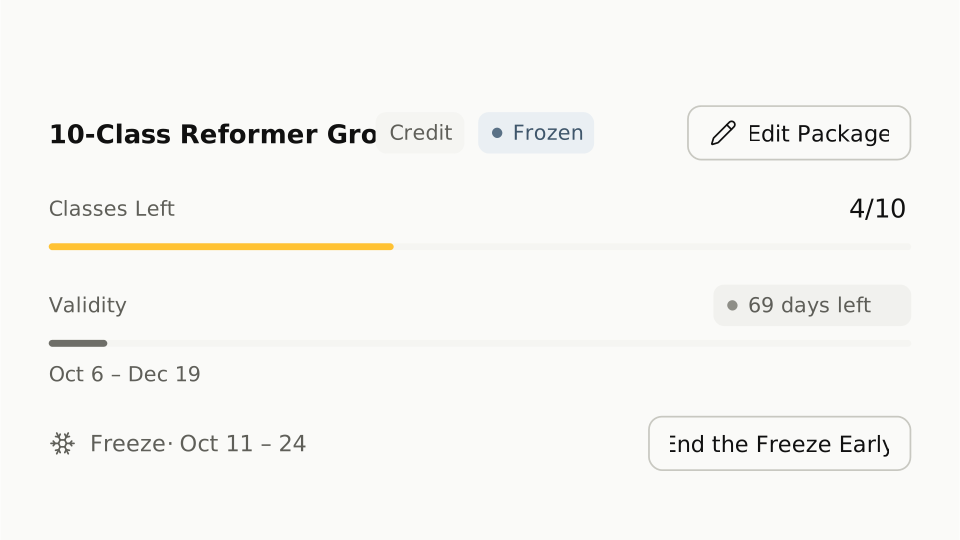
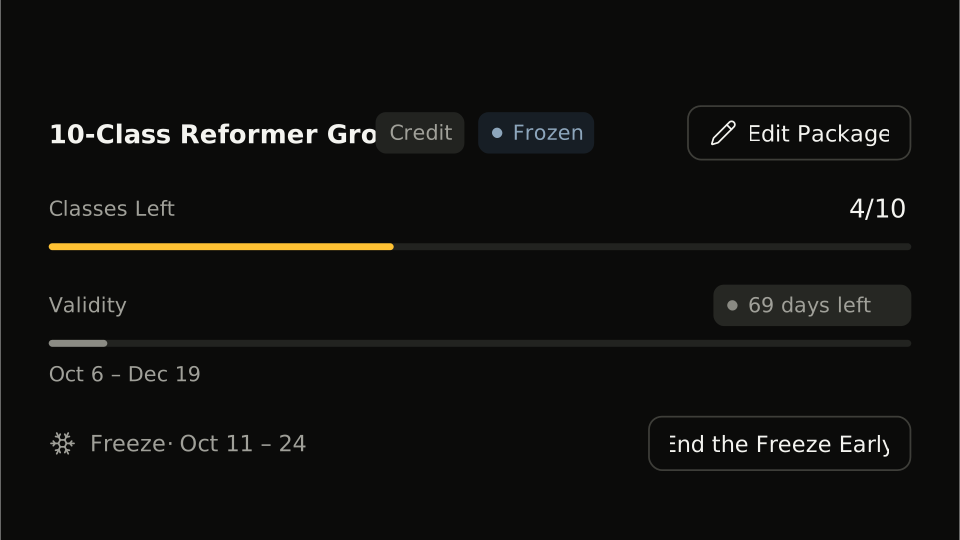
A freeze moves the package end date out by the days it was frozen, so the package does not run down while the member is away. How many times and for how many days it can be frozen is written in the package definition, so no request is negotiated on its own. A freeze starts today or later, never in the past, and days left unused by an early return are taken back.
- The number of freezes and the longest single freeze are written in the package definition
- A freeze starts today or later and is never back-dated
- Bookings inside the range, if removed, return their held credits to the package
- Unused days of a member who returns early are taken back from the end date
The question asked most before the summer is "will my package expire?". When the answer is already in the package definition, the front desk does not have to decide again for every member. Extra rules, such as a minimum of one week or how many days ahead a freeze must be asked for, should also be written down and announced before the holidays.
In the glossary: Package freeze
How do holiday closures go into the schedule?
A closure is entered by blocking the date range, not by deleting sessions one by one. Before the block is saved, the sessions it would cancel are listed and a confirmation is asked for. Once confirmed they become studio cancellations: a member who booked with a class credit gets the held credit straight back in the package, and everyone who had booked receives a cancellation notice.
- Date-range block
- One-off closures such as a public holiday or the annual break: a first and last day, and certain hours of the day if needed.
- Weekly block
- Recurring closures such as being shut every Saturday through the summer: the weekdays and an hour range.
A block is placed on a room or on an instructor. On days the whole studio is shut, each room gets a block of its own; on days only one instructor is away, a block on that instructor is enough. Sessions inside a block count as studio cancellations, so they never use up the member's own cancellation allowance.
Studio cancellations and make-up rules: Make-ups and Freezing
How do you reduce the class timetable for the summer?
Reducing starts with merging the quiet hours: two half-full morning classes on the same day become one, and the busiest evening hours stay as they are. That brings instructor hours and the fixed cost of the studio closer to actual demand. The change applies from a date, and the return to the full timetable in September is announced up front, so members know what is temporary.
- Merge half-full classes within the same day
- Leave the busiest evening hours alone
- Apply the change to the series from a date, leaving past weeks as they were
- Announce the September return to the full timetable from the start
Present the reduced timetable as following the rhythm of the summer rather than as a loss: "in summer the 7 AM class moves to 8 AM" loses fewer members than "we dropped the morning class". Building the timetable once and keeping it steady for the whole summer, instead of changing it weekly, also protects the habits of regular members.
How do you set up a summer package?
A summer package is a short offer for members who stay in town but want nothing long: a validity of a few weeks, a small number of class credits and a scope limited to the classes on the summer timetable. It is switched on at the start of the summer and set inactive when it ends. The rules are copied onto each sold package, so later edits do not touch packages already sold.
- Short validity: a span covering a few weeks of the summer
- A small number of class credits or a weekly class limit
- Scope: only the classes open on the summer timetable
- Sales window: active at the start of summer, inactive in September
A summer package should not be a discounted copy of the regular one. So as not to keep a member who returns to a regular package in September waiting, pick its validity to match when schools and offices come back.
Package types and their rules: Class Package Rules
How do you plan cash for the slow months?
Rent, salaries and bills do not drop in the summer; collections do. So the gap of the slow months is closed with a reserve set aside in the busy ones. The arithmetic is simple: put last year's monthly collections next to the fixed costs, and the total of the months that come out negative is the size of the reserve. It is built by setting aside part of the spring surplus.
| Month | Collected | Fixed costs | Difference |
|---|---|---|---|
| May | 190,000 TL | 150,000 TL | +40,000 TL |
| June | 160,000 TL | 150,000 TL | +10,000 TL |
| July | 125,000 TL | 150,000 TL | -25,000 TL |
| August | 115,000 TL | 150,000 TL | -35,000 TL |
In this example the gap of July and August comes to 60,000 TL. Since the surplus of May and June is 50,000 TL, part of the reserve has to come from the earlier spring months too. Once the reserve is set aside the summer stops being a surprise, and the rent no longer waits on September's collections.
The figures in the table are an example. For your own studio, use last year's actual collections and this year's fixed costs, and remember to count the fixed pay of instructors among the fixed costs.
With your own numbers: Break-even calculator
Tracking collections and costs: Studio Cash Flow
How is the summer season managed in Dakik?
In Dakik the freeze allowance is set in the package definition and copied onto the member's package at sale, and a member can start a freeze within those rules from their own panel. Closures are entered as room or instructor blocks, with the sessions they would cancel shown in a preview. The summer timetable is built by editing recurring series from a date, and a summer package can be saved inactive until its time comes.
- The number of freezes (1-12) and the longest freeze (1-365 days) are set in the package definition
- A member can start a freeze their package allows from their own panel
- Ending a freeze early is open to the Owner and Admins; the unused days are taken back
- Room and instructor blocks are entered as a date range or a weekly repeat
- Before a block is saved, the planned sessions it would cancel are listed for confirmation
- A package definition can be saved inactive; it is not sold, and packages already sold run on
On the features page: Make-up Pool and Freezing
Frequently asked questions
Can a package with no freeze allowance be paused for a holiday?
Not by the member: the freeze allowance comes from the package at the moment of sale, and without one no freeze opens. If the studio still wants to make an exception, the Owner or an Admin can move the end date of the sold package with Edit the Package. That is a decision rather than a rule; if it happens every summer, adding a freeze allowance to the package definition is fairer.
What happens when a Duration package member loses a class to a holiday closure?
A Duration package counts no class credits, so there is no credit to give back; the seat in that session is simply removed. For a long closure, a studio that wants to make good the loss can freeze the package for the length of the closure or move its end date out. Whichever it chooses should be said in the closure announcement.
What happens to the classes of an instructor on summer leave?
There are two ways. If the classes go on, the instructor of those sessions is changed to a substitute for the leave, and the classes count toward the substitute's pay. If they stop, the leave goes in as a date-range block on the instructor and the sessions inside it become studio cancellations once confirmed. The affected sessions are listed before the block is saved.
How do you bring members back at the end of the summer?
Announce the September timetable in mid-August and reach out one by one to members whose package ended over the summer. Watching the packages that are about to end is enough for that: the Overview page shows how many packages end in fewer than ten days. A first-week class or a time-limited package gives an undecided member a reason to come back.