How do you find the class times that stay empty?
A weekly occupancy average hides empty slots: evening classes can overflow while lunchtime classes run half empty and the average still looks fine. Read occupancy by time slot, separately, over a period of at least four weeks. One empty week can be chance; a slot that stays empty four weeks running is a pattern, and a pattern is something you can act on.
- Read occupancy by time slot rather than as a weekly average
- Choose a period of at least four weeks; one empty week can be chance
- Split the same time by day: Tuesday lunchtime can be full and Thursday lunchtime empty
- Note separately the slots with a waitlist: they show where the demand is
- Write the instructor and the kind of class beside each slot's occupancy; a shared cause is often there
How do you work out occupancy per time slot, with an example?
Occupancy is the places taken divided by the places offered. For each time slot, add up the capacity and the bookings of its sessions separately, then divide, so a large session does not count the same as a small one. In the example below the weekly average comes out at 59%, while the individual slots range from 30% to 97%.
Occupancy = places taken ÷ places offered (the sum of the sessions' capacities) × 100
| Time slot | Sessions | Places offered | Places taken | Occupancy |
|---|---|---|---|---|
| 07:30 | 3 | 30 | 12 | 40% |
| 10:00 | 3 | 30 | 9 | 30% |
| 12:30 | 3 | 30 | 15 | 50% |
| 18:30 | 3 | 30 | 29 | 97% |
| 20:00 | 3 | 30 | 24 | 80% |
| Total | 15 | 150 | 89 | 59% |
The studio in this example could look at a 59% week and relax. Yet its 18:30 classes are about to overflow and probably have a waitlist, while its 10:00 classes fill only three of ten places a session. The slot to fill is 10:00, followed by 07:30; 18:30 is the one that might need a second session.
The figures in the table are a worked example, not industry data. The total row is worked out from all the places, not as an average of the sessions, so large and small sessions each count with their own weight.
Your own break-even occupancy: Studio Break-Even and Occupancy Calculator
Term: Occupancy rate
Why does a class time stay empty?
Usually the time is not wrong; the class at that time is offered to the wrong people. An advanced class built for the evening crowd at lunchtime, a long class early in the morning, or a slot that depends on a single instructor stays empty. First ask who could come at that time, then change the class, its length and its level to suit them.
- The wrong audience
- The class is built for people who cannot come at that time, such as an advanced class at lunchtime aimed at the evening crowd.
- The wrong length
- A class that does not fit into a lunch break is not chosen even at a convenient time. A shorter one can fill the same slot.
- A slot nobody sees
- Members do not know it exists; it is on the timetable but was never announced.
- A slot tied to one person
- It was opened around one instructor's timetable or a few loyal members, and emptied when they changed.
How do you set up a separate package for empty times?
Define the classes in your empty slots as separate classes under a name of their own, and set up a cheaper package that can only be used on those classes. The lower price then goes only to the times you want to fill, not across the whole timetable. A member who wants evening classes still buys the full package; the daytime package opens a door to new people who can come in the day.
- Define the classes in empty slots under a class name of their own, such as "Daytime Reformer"
- Set the package up so it can only be used on those classes; evening classes stay outside its scope
- Price it below the full package, but high enough to cover the break-even occupancy of the empty slot
- If it is a duration package, set a weekly class limit so one member does not take every free place
- Launch the package together with an announcement aimed at people who can come during the day
A package's scope works by class, not by time of day. That is why defining the daytime class separately from the same class in the evening is what stops the daytime package being used in the evening.
Package scope and the weekly limit: Class Package Rules
Should you merge two half-empty classes?
If two classes close together on the same day keep running half empty, merging them turns two empty classes into one full one and frees an instructor hour. Because it is a change for members, announce it in advance with the reason, and offer another option to anyone the new time does not suit. Members of the dropped session should get their credits back without losing any.
Look at four weeks of occupancy
Check that both classes have run half empty for at least four weeks in a row, and that the combined number stays within capacity.
Choose the time to keep
Keep the fuller time, the one more members can easily make, or the one that builds a waitlist.
Tell members in advance
Announce the change at least a week ahead, with the reason and the new time.
Move or cancel the session
Move the dropped time's sessions to the time you keep; give back the credits of any booking that cannot move, in full.
Talk to the members it does not suit
Offer another option to anyone who cannot make the new time, so a merge does not turn into a lost member.
Merging is not always right: if the two classes are at different levels, or one serves a particular group, a merge can leave both sets of members unhappy. Changing the time instead of the class can work better then.
How does the waitlist help fill empty times?
The waitlist of a full slot is a list of members who want to come at that time but cannot get a place. Offering them the empty class at a nearby time gets the waiting member into a class and fills the empty slot at once. A slot with a long waitlist is also a sign to open another session: the demand is at that time, not across the timetable.
- Offer members on a full slot's waitlist the empty class at a nearby time
- A slot whose waitlist stays long for weeks is a sign to open another session
- Opening the new session in place of an empty slot meets the demand without growing the timetable
- A member on the waitlist is notified when a place opens; a member who moves to the empty slot gets into class straight away
How do you steer trial classes into empty slots?
Open trial classes only in sessions that have free places. Someone who tries a full evening class cannot get a place when they want to carry on; a trial in an empty slot fills that slot and shows the newcomer a time they really can keep coming to. An announcement aimed at people free during the day works together with limiting the trial page to those classes.
- Offer only classes with free places on the trial page
- Keep full evening classes off the trial page, so a newcomer does not get used to a time they cannot keep
- Offer the daytime package to a newcomer who tried a daytime class
- Keep the number of days ahead the trial page shows short; a free place in the next few days is easier to choose
From trial class to membership: Turning Trial Classes into Members
Where does Dakik show empty times, and how do you fill them?
In Dakik the Overview page, which the Owner and Admins see, shows this week's number of sessions and its capacity-weighted average occupancy, and each session card on the calendar shows its own occupancy. A package definition chooses which classes the package can be used on, and duration packages can carry a weekly class limit. Sessions are moved by dragging, and the trial page only offers sessions of the chosen classes that still have places.
- Overview: this week's number of sessions and capacity-weighted average occupancy
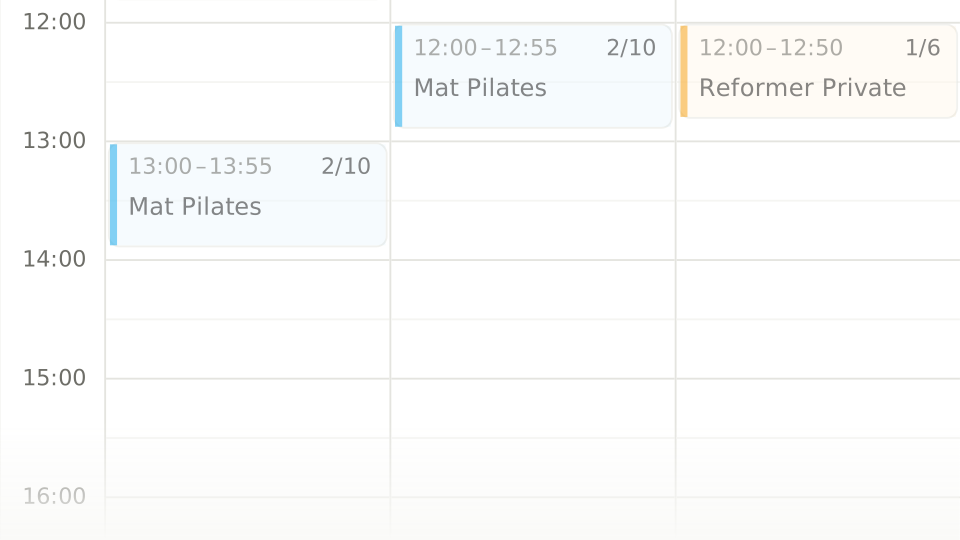
- Calendar: each session card shows its places taken and its capacity
- Package scope: the package definition lists, one by one, the classes the package can be used on
- Weekly class limit: a duration package can carry a weekly cap of 1 to 50 classes
- Moving sessions: a session is dragged to a new slot, and in a recurring series this one and the following ones can move together
- Studio cancellation: the credits held by a canceled session go straight back to the package
- Waitlist: when a place opens in a full session, the member on the list is notified
- Trial page: only sessions of the chosen classes, within the chosen number of days and with free places, are offered
The calendar and sessions: Schedule
Frequently asked questions
Should you discount empty times or set up a separate package?
A separate package is usually healthier. A temporary discount leaves an expectation that is hard to withdraw once the slot fills, and pushes members of full slots to ask for it too. A package that only covers certain classes is a permanent product: its price is set by how full those times really are, and it leaves the price of every other package alone.
Should you close a class time that stays empty?
Yes, if it is still empty after you have tried changing the class, the length, the level and the package. An empty session still costs instructor pay, the room and energy; closing it and adding a second session to a full slot often pays better. Before closing it, tell the few members who come at that time and offer them another time that suits them.
What is a good occupancy rate for a studio?
There is no single rate that holds for everyone; a good rate is the one that covers your costs. Rent, instructor pay and class prices vary from studio to studio, so the break-even occupancy varies too. Work out your own break-even point first, then read each time slot against that line: the slots below it go to the top of the list to fill.
Who should you aim daytime classes at?
People free during the day are often shift workers and people working from home, parents after the school run, retirees and pregnant women. What they want from a class can differ from the evening crowd: shorter, calmer, or in a smaller group. Building the announcement and the class around the same people is what fills a daytime slot for good.