How do you package clinical pilates sessions?
Clinical pilates is mostly packaged around the length of a treatment plan: two sessions a week for six or eight weeks, so 12 or 16 sessions. One-to-one sessions, duo sessions and small groups are sold as separate packages, and when a client's plan changes a new package is defined. If the first assessment is sold as a session of its own, it does not come out of the package's credits.
| How It Is Sold | Package Type | Credits | Validity | Who It Suits |
|---|---|---|---|---|
| First assessment | Credit | 1 session | 14 days | A client coming to the studio for the first time |
| One-to-one, 12 sessions | Credit | 12 sessions | 60 days | A six-week plan at two sessions a week |
| One-to-one, 16 sessions | Credit | 16 sessions | 75 days | A longer recovery |
| Small group, 8 sessions | Credit | 8 sessions | 45 days | A client ready to move to a group |
The session counts and periods are an example; the right plan is the physiotherapist's decision. In Dakik each package is defined for one class type and can be limited to chosen classes: tying the assessment package to the Assessment class alone stops it being spent on a normal session.
Definition of the term: Credit package
Small group or one-to-one session?
Clinical pilates usually starts one-to-one: the physiotherapist gets to know the client and chooses the exercises for them. Once the client does the exercises with confidence they can move to a group of three or four people with similar needs; the price of a session falls and the instructor's hour reaches more people. Which client is ready for a group is always the physiotherapist's decision.
| Session Format | Capacity | When It Suits |
|---|---|---|
| Private | 1 person | Assessment, the first weeks, a period the physiotherapist must watch closely |
| Duo | 2 people | Two clients at a similar stage, such as family members coming together |
| Group | Up to the room's capacity, such as 3 or 4 | Clients with similar needs who do the exercises with confidence |
A Private and a Duo session's capacity is fixed by the class type, while a group's ceiling is the room's capacity. With the room defined for 4 people, the calendar will not let a fifth person into a small group.
What one-to-one and group sessions earn per hour: Group vs Private Class Profitability
How do you set up a first assessment session?
The first assessment is the session where the client meets the studio and the physiotherapist draws up the plan; its length and price can differ from a normal session. Opening it as a class of its own makes it easy to set aside assessment hours on the calendar and sell it as a single-session package. The findings of the assessment go into the studio's clinical record, not its management software.
Open the assessment as a class of its own
A class name is at most 40 characters; a short name such as "Assessment" makes first sessions easy to spot on the calendar.
Define a single-session package
Put only the assessment class in the package's scope, so the credit is used in that session alone.
Register the client and plan the session
Add the client as a member, define their package and place them in the assessment session; a member with no email can be registered without signing in to the app.
Turn the plan into a package
After the assessment, define the plan the physiotherapist proposes as a one-to-one or group package and tie the weekly slots to a series.
How do you group sessions by need?
Building small groups around similar needs rather than age or time of day makes the session more useful for everyone: back and neck complaints, the months after giving birth or recovery for athletes, for example. The group's name should say what the session focuses on, never a client's diagnosis.
- Each small group can open as a class of its own under its own name; the name says what the session focuses on, not the client's diagnosis
- The level field tells Beginner, Intermediate and Advanced apart; adding a client of a different level to a session asks for a reason
- For a group class the room's capacity should be entered as the group's real size
- A client's standing place in a group is kept every week by adding them to the series as a standing member
The groups are an example, not a treatment recommendation. Who joins which group, which movement suits them and when to go back to one-to-one are the physiotherapist's clinical decisions.
What is the health note for, and what is it not for?
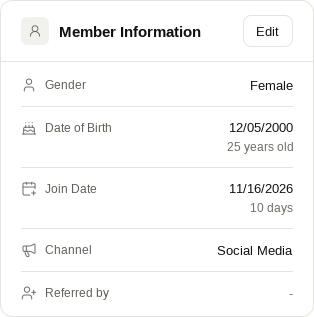
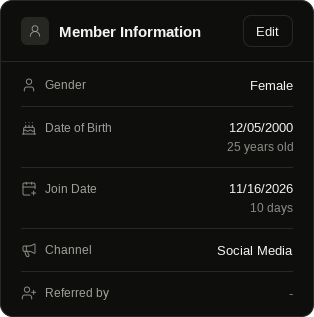
The health note in Dakik is a short note telling the instructor what they need to know before a session: an injury, an operation or a pregnancy, for example. It is not a medical record, an assessment form or a treatment history, and it should never stand in for them. Who writes the note, who sees it and where it is never used are set out one by one below.
- What it is
- A free text of at most 2000 characters. It says the short thing an instructor needs to know; it is not built for a diagnosis, a treatment history or a record of measurements.
- When staff write it
- It goes in the Health Notes field of the member form; there is no box to tick. The studio is the data controller for its records, and if the client's consent is needed, obtaining it is the studio's job; Dakik does not check it.
- When the client writes it
- A client gives their explicit consent to write their own note on their Profile; Dakik records when the consent was given. Withdraw Consent deletes the note.
- Who sees it
- The studio's staff and the client themselves. Other clients cannot see it.
- Where it never appears
- Exported CSV files, notification texts, emails, global search results and the WhatsApp assistant.
When a client changes their note, instructors who will teach one of their upcoming sessions get a Health Note Updated notification; the notification does not contain the note. When a client is made inactive, the health note and the consent are deleted.
The explicit consent to health data: Explicit Consent to Health Data
Where should treatment records and reports be kept?
Assessment forms, measurements, doctors' reports and session-by-session treatment notes are the studio's clinical record, kept according to the physiotherapist's professional obligations. Those records need the studio's own system or files. Management software keeps the session, the package, the payment and the pay; keeping the two records apart makes it clear which data sits where and who is responsible for it.
- Dakik does not let a document, report, image or file be attached to a member
- Assessment findings, measurements and session-by-session treatment notes are kept in the studio's clinical record
- Something about the session that has nothing to do with health, such as "likes to arrive early", goes in the Studio Note field; the client does not see that note
- Agree in writing in advance where the clinical record stays when a physiotherapist leaves the studio
How do you plan a re-assessment at the end of a package?
When the end of a treatment plan falls together with the end of a package, there is a natural moment for a re-assessment: has the client progressed, can they move to a group, is the plan finished? Knowing that a package is nearing its end and putting that conversation on the calendar ahead of time stops a client quietly drifting away. A freeze allowance should be written in for illness or an operation too.
- A client whose package nears its end gets the Renew Your Package notification and can send a renewal request from their Profile; the Packages Ending figure on the Members page counts those clients
- Placing the re-assessment in one of the last sessions means the next plan is discussed before the package runs out
- A package can allow freezes; the client or the studio freezes the package for an illness or an operation, and the end date moves on by as much
- A sold package's dates, price and session credits can be changed with Edit Package
A freeze cannot start in the past, and the client is taken out of the sessions in the frozen range with their credits returned to the package. So once an operation date is known, recording the freeze ahead of time keeps the calendar clean too.
Keeping a client once the package ends: Member Retention
How do you pay a clinical pilates instructor?
At clinical pilates studios an instructor is mostly paid per class, per participant, by revenue share or on a fixed salary. At a studio where one-to-one sessions dominate, a per-class fee can be fairer, and where small groups are the majority, per-participant pay can be. Because an assessment session is different work, it can carry its own amount too.
- Per Class
- An amount per session; the clearest model where one-to-one dominates. The assessment class can carry its own amount.
- Per Participant
- An amount for every client marked Attended; it gives the instructor a stake in filling small groups.
- Revenue Share
- A share of the class value of the clients who attended; suits an instructor who brings their own clients.
- Monthly Fixed
- A salary whatever the number of sessions; suits a physiotherapist who also runs the studio.
Under the per-class model a session with a client's seat counts even if the client did not come; under per-participant pay and revenue share only clients marked Attended count. Bonuses and the details of each model are in the payroll guide.
The five pay models in detail: Instructor Pay Models
Run it with your own numbers: Instructor Pay Calculator
Which parts of a clinical pilates studio does Dakik run?
Dakik runs session planning on an instructor and room calendar, applies session packs with their rules and works out instructor pay from attendance. One-to-one, duo and small group sessions sit on the same calendar, and the short health note an instructor needs is shown to the studio's staff only.
While the instructor focuses on the session, Dakik handles the rest:
- It keeps one-to-one, duo and small group sessions on an instructor and room calendar, and shows a conflict before you save
- It applies session packs with their cancellation, make-up and freeze rules, and shows the client their remaining credits
- It shows the short health note an instructor needs before a session to the studio's staff only
- It records the explicit consent a client gives for their own note, and its withdrawal
- It works out instructor pay from attendance under the chosen model
Dakik for clinical pilates studios: Clinical Pilates Studio Software
Client records and the health note: Members
Defining a session pack: Member Packages
Frequently asked questions
Can a doctor's report or a referral be attached in Dakik?
No. Dakik attaches no document, report or file to a member. A client's report or referral is kept in the studio's clinical record. The short piece of information an instructor needs before a session, such as which movement to avoid, can go in a few sentences in the health note.
Can an invoice be issued for insurance or the state health system?
No. Dakik issues no invoices or e-invoice documents and does not connect to insurers, Turkey's SGK social security system or the e-Nabız health record. The studio records the payment and keeps track of its income and what a client owes; it issues the official document with its own accounting software.
What does a client see in the app?
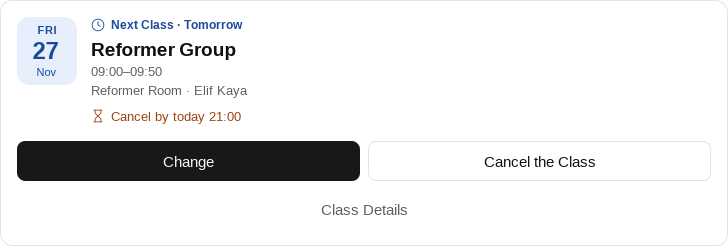
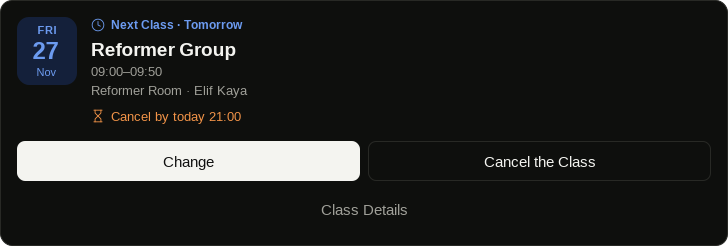
A client sees their own sessions, package, remaining session credits, payments and standing slot, and cancels or moves a session as far as the rule allows; the studio, not the client, books a new session. By giving their consent they can write their own health note. They do not see other clients, their notes or what the studio writes in the Studio Note field.
Can a home exercise program be shared through Dakik?
No. Dakik keeps no exercise programs or videos. A home program has to be shared with the tool the studio already uses. To send a client a notice or reminder about a session, the app's notifications can be used.